Crude fibre vs dietary fibre in pet food
The fibre figure on a pet food label is a laboratory residue, not a count of all the fibre a dog eats. Here is how crude fibre and total dietary fibre are measured, how far apart they sit, and what changes when labels switch.
- US labels must guarantee a crude fibre maximum, and “crude” names the analytical method, not the nutrient.
- In a 12-food study, crude fibre gave the lowest values of four fibre methods and total dietary fibre the highest.
- In 19 therapeutic dog diets, soluble fibre, which the crude method loses, was a median 30.4% of total dietary fibre.
- Under AAFCO label modernization a total dietary fibre maximum replaces crude fibre, so declared fibre will usually rise.
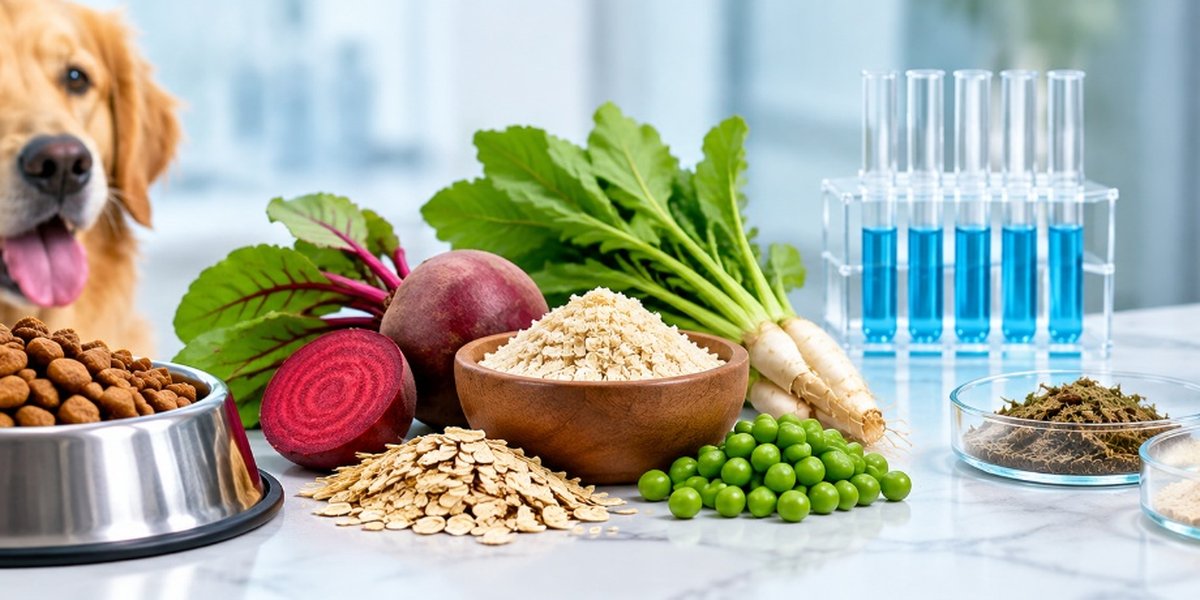
Crude fibre is what is left after a sample is boiled in dilute acid and then alkali. It is the fibre line US labels must carry, as a maximum 1. Total dietary fibre (TDF) is measured with enzymes and captures soluble and insoluble fibre. In a 12-food study, crude fibre gave the lowest values of four fibre methods and TDF the highest 2. So the panel figure usually reads lower than the fibre a dog actually eats.
01What crude fibre means on a US label
Under AAFCO model rules, every US pet food label must guarantee four things: minimum crude protein, minimum crude fat, maximum crude fiber and maximum moisture. “Crude” names the analytical method, not the nutrient. Crude protein, for example, is measured nitrogen multiplied by 6.25 1. Crude fibre is, in the same way, “fibre as this method counts it”. Our guide to the guaranteed analysis covers the other lines.
02How each figure is measured
The crude fibre method (Weende) boils the sample in 1.25% sulfuric acid, washes it, then boils it in 1.25% sodium or potassium hydroxide. The residue counts as fibre. The acid step removes sugars and starch. The alkali step also removes protein, some hemicellulose and part of the lignin, and soluble fibre is lost 3. What remains is mostly cellulose.
Total dietary fibre uses enzymes to digest starch and protein, as the gut would, and weighs what resists them. AOAC 991.43 reports soluble and insoluble fractions separately. Like the older AOAC 985.29, it misses low-molecular-weight oligosaccharides such as FOS and inulin. Integrated methods such as AOAC 2009.01 and 2011.25 recover these and resistant starch 4.
| Feature | Crude fibre | Total dietary fibre |
|---|---|---|
| Principle | Acid then alkali boil; residue weighed 3 | Enzyme digestion; resistant residue weighed 4 |
| Soluble fibre | Lost 3 | Counted (high molecular weight) 4 |
| Hemicellulose and lignin | Partly lost 3 | Counted 4 |
| Oligosaccharides (FOS, inulin) | Lost | Only with integrated methods (2009.01, 2011.25) 4 |
| US label today | Required maximum 1 | Optional now 1; replaces crude fibre under label modernization 5 |
Table 1. Crude fibre and total dietary fibre compared. A proximate analysis panel includes crude fibre by default; TDF is a separate test.
03How big the gap is
A Brazilian study fed six dry dog and six dry cat foods and measured fibre by up to four methods in food and faeces. Crude fibre gave the lowest values and TDF the highest, with neutral and acid detergent fibre in between. Crude fibre in food did not correlate with any other method. Crude fibre was also almost entirely indigestible, so it tracks only the fibre that passes through unchanged 2. The study was funded by FAPESP and Mogiana Alimentos, a pet food maker.
Estimated by regression across six dry dog foods; the study reports crude fibre only as “close to zero” 2. Axis 0–100%.
View data table
| Method | True digestibility in dogs (%) |
|---|---|
| Crude fibre | Close to zero |
| Acid detergent fibre | 26 |
| Total dietary fibre | 37 |
| Neutral detergent fibre | 53 |
Soluble fibre is the largest blind spot. In 19 commercial therapeutic dog diets, 11 dry and 8 canned,, soluble fibre made up a median 30.4% of TDF, ranging from 9.4% to 53.7% 6. The crude method does not see that share at all 3.
04Why the gap matters for energy
Carbohydrate on a pet food is usually calculated by difference. If the fibre term is crude fibre, the uncounted soluble fibre is added to carbohydrate, so in our reading both carbohydrate and predicted energy drift up. Energy equations show the same pattern. In 335 AAFCO-protocol feeding trials at one Royal Canin site, the NRC 2006 equation using TDF with measured gross energy matched measured metabolisable energy without significant bias. The crude-fibre version underestimated dry foods and overestimated wet foods 7. Royal Canin funded the study, and a correction was issued in 2025. Our article on label vs measured calories goes further.
05What fibre does in the dog
More fibre is not automatically better, and the type matters as much as the amount.
- Insoluble fibre. In 24 beagles, guava fibre at 3, 6 or 12% lowered digestibility of dry matter, protein and energy, and lowered metabolisable energy. The authors class it as insoluble and non-fermentable 8.
- Legume and functional fibre. In 12 beagles, a garbanzo bean diet with a fibre and prebiotic blend plus a probiotic treat lowered dry matter and energy digestibility and raised dry faecal output 9.
- Whole grain. Whole-grain rye at half the dry matter, replacing refined wheat, lowered protein, fat and energy digestibility in six beagles and shifted faecal microbiota 10.
None of these effects can be read from a crude fibre figure. All three are small studies on specific fibres, so they show direction, not a dose rule.
06Reading and setting the fibre line
Fibre varies widely between products. Laboratory analysis of 61 US adult and senior dog diets found fibre, fat and energy density the most variable nutrients, especially in canned food 11. On European pack labels, plant-based dry dog foods declared about twice the fibre of animal-based ones 12.
Declared label values for products launched 2020–2024, not laboratory measurements 12. Axis 0–8 g/100 g.
View data table
| Dry dog food type | Mean declared fibre (g/100 g) |
|---|---|
| Plant-based | 5.80 |
| Hybrid | 3.28 |
| Animal-based | 2.66 |
The label is changing too. Under AAFCO label modernization, a total dietary fibre maximum replaces crude fibre, listed under total carbohydrate. The fibre in the food does not change, but the declared number will usually rise 5. States adopt the rules on their own schedules.
Before you set or compare a fibre figure
- Check which method the number comes from: crude fibre, TDF (and which AOAC method), or neutral detergent fibre.
- Compare products on a dry matter or per-1,000 kcal basis, not as fed.
- Run TDF when the recipe uses beet pulp, legumes, gums, inulin or FOS, and pick a method that recovers oligosaccharides.
- Set the guarantee from several measured batches, not one result.
Crude fibre is a regulatory ceiling, not a measure of total fibre. It misses soluble fibre and partly fermentable fractions, so use TDF whenever energy, carbohydrate or stool quality matter, and plan now for TDF on the label.
07For brands and formulators
08Questions brands ask
What is crude fibre in dog food?
It is the residue left after a sample is boiled in dilute acid and then alkali. It is mostly cellulose with some lignin, and US labels must show it as a maximum.
What is the difference between crude fibre and dietary fibre?
Crude fibre loses soluble fibre and part of the hemicellulose and lignin. Total dietary fibre is measured with enzymes and counts both soluble and insoluble fibre, so it is the more complete figure.
Why is total dietary fibre higher than crude fibre?
The acid and alkali steps dissolve fractions that the enzymatic method keeps. In one 12-food study, crude fibre gave the lowest values of four fibre methods and total dietary fibre the highest.
Is more fibre better in dog food?
Not necessarily. In small beagle studies, added guava fibre, whole-grain rye and a legume and prebiotic diet all lowered some nutrient digestibility, so the type and amount should suit the product.
Will pet food labels show total dietary fibre?
Yes, in the US. Under AAFCO label modernization a total dietary fibre maximum replaces crude fibre, and states adopt the rules on their own schedules.
Read the label verification guides in order
- Guaranteed analysis explained · what each line means
- Crude fibre vs dietary fibre · you are here
- How accurate are pet food labels? · one label vs lab study explained
- Calories in dog food · label vs measured energy, graded
- Proximate analysis of pet food · methods, tolerances and turnaround
- Worked case study · a dog treat label checked across four batches
- Nutritional analysis · how we run it for your product
Sources
- Association of American Feed Control Officials. Reading labels: understanding pet food. AAFCO; accessed November 2026. Source ↗
- de-Oliveira LD, Takakura FS, Kienzle E, Brunetto MA, Teshima E, Pereira GT, Vasconcellos RS, Carciofi AC (2012). Fibre analysis and fibre digestibility in pet foods: a comparison of total dietary fibre, neutral and acid detergent fibre and crude fibre. Journal of Animal Physiology and Animal Nutrition 96(5):895–906. Source ↗
- VELP Scientifica. Crude fiber analysis: the Weende method. Instrument maker technical page; accessed November 2026. Source ↗
- Megazyme. Dietary fiber analysis: a brief history. Reagent maker technical page; accessed November 2026. Source ↗
- Pet Food Institute. Advancing the transparency of pet food labels: understanding the importance of total dietary fiber. PFI; accessed November 2026. Source ↗
- Farcas AK, Larsen JA, Owens TJ, Nelson RW, Kass PH, Fascetti AJ (2015). Evaluation of total dietary fiber concentration and composition of commercial diets used for management of diabetes mellitus, obesity, and dietary fat-responsive disease in dogs. Journal of the American Veterinary Medical Association 247(5):501–507. Source ↗
- Calvez J, Weber M, Ecochard C, Kleim L, Flanagan J, Biourge V, German AJ (2019). Metabolisable energy content in canine and feline foods is best predicted by the NRC2006 equation. PLoS ONE 14(9):e0223099. Correction: PLoS ONE 2025;20(3):e0319808. Source ↗
- Monti M, Loureiro BA, Pedreira RS, Mendonça FS, Putarov TC, Villaverde C, Carciofi AC (2024). Guava fibre characterization and effects on digestibility, fermentation products, gastrointestinal transit time and palatability of dry diets for dogs. Journal of Animal Physiology and Animal Nutrition 108(2):500–510. Source ↗
- Wilson SM, Kang Y, Marshall K, Swanson KS (2024). Effects of dietary fiber and biotic supplementation on apparent total tract macronutrient digestibility and the fecal characteristics, metabolites, and microbiota of healthy adult dogs. Journal of Animal Science 102:skae138. Source ↗
- Palmqvist H, Ringmark S, Höglund K, Pelve E, Lundh T, et al. (2023). Effects of rye inclusion in dog food on fecal microbiota and short-chain fatty acids. BMC Veterinary Research 19:70. Source ↗
- German K, Melgoza C, Torres-Henderson C (2025). Exploratory analysis of nutrient composition of adult and senior dog diets. Frontiers in Veterinary Science 12:1717409. Source ↗
- Boukid F, Rosentrater KA (2025). Nutritional profiling and labeling practices of plant-based, hybrid, and animal-based dog foods: a study of European pack labels (2020–2024). Animals 15(13):1883. Source ↗
Evidence reviewed by the Guires Pet Nutrition Lab scientific team. This article is general information for product developers and is not legal or veterinary advice.
How to cite this article
Choose your referencing style, then copy. Check your university’s, journal’s or regulator’s guide for local variations.
Mehta, P. (2026, November 13). Crude fibre vs dietary fibre in pet food. Guires Pet Nutrition Lab Insights. https://www.petnutritionlab.com/insights/crude-fibre-vs-dietary-fibre-pet-food
Mehta, Priya. “Crude fibre vs dietary fibre in pet food.” Guires Pet Nutrition Lab Insights, 13 Nov. 2026, www.petnutritionlab.com/insights/crude-fibre-vs-dietary-fibre-pet-food. Accessed [date].
Mehta, P. (2026) Crude fibre vs dietary fibre in pet food. Available at: https://www.petnutritionlab.com/insights/crude-fibre-vs-dietary-fibre-pet-food (Accessed: [date accessed]).
Mehta, Priya. “Crude fibre vs dietary fibre in pet food.” Guires Pet Nutrition Lab Insights. November 13, 2026. https://www.petnutritionlab.com/insights/crude-fibre-vs-dietary-fibre-pet-food.
Priya Mehta, ‘Crude fibre vs dietary fibre in pet food’, Guires Pet Nutrition Lab Insights, 13 November 2026, <https://www.petnutritionlab.com/insights/crude-fibre-vs-dietary-fibre-pet-food>, accessed [date accessed].
Mehta P. Crude fibre vs dietary fibre in pet food [Internet]. Guires Pet Nutrition Lab Insights; 2026 Nov 13 [cited [date]]. Available from: https://www.petnutritionlab.com/insights/crude-fibre-vs-dietary-fibre-pet-food
P. Mehta, “Crude fibre vs dietary fibre in pet food,” Guires Pet Nutrition Lab Insights, Nov. 13, 2026. [Online]. Available: https://www.petnutritionlab.com/insights/crude-fibre-vs-dietary-fibre-pet-food
@misc{guirespnl2026crudefibrevsdietaryfibrepetfood,
  author = {Mehta, Priya},
  title = {{Crude fibre vs dietary fibre in pet food}},
  year = {2026},
  month = oct,
  howpublished = {\url{https://www.petnutritionlab.com/insights/crude-fibre-vs-dietary-fibre-pet-food}},
  note = {Guires Pet Nutrition Lab Insights}
}
This article summarises published evidence for product developers. Cite the original sources above for specific findings, and do not reproduce this article as your own work.
Need fibre measured the right way?
Tell us your fibre sources and claims. We choose between crude fibre and total dietary fibre methods and interpret the gap.