Kibble coatings: fats, digests and palatants after extrusion
What goes onto kibble after the dryer, why the method, order and timing of each layer change palatability and shelf life, and a troubleshooting table for the faults we see most often.
- Most dry food leaves the dryer lean and porous; fat, liquid digest, dry palatant and any probiotic are applied afterwards in a drum or vacuum coater.
- Vacuum coating draws more fat into the pores and suits high-fat or dense kibble; below about 2% coating, kibble tends to look patchy.
- Timing matters: in a 40-cat study, adding powder palatant 24 hours after the fat improved palatability at every fat level tested.
- Probiotic claims on coated kibble need end-of-shelf-life counts; one survey found no diet contained all its listed organisms.
01The short answer
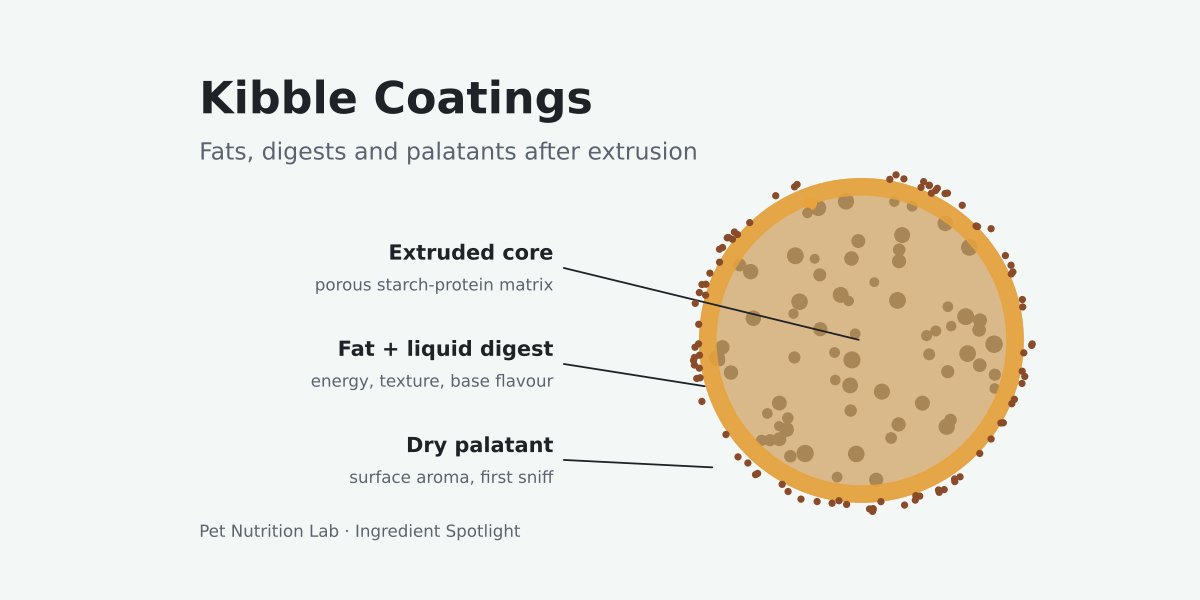
What goes onto kibble after extrusion? Most dry food leaves the dryer as a lean, porous base. It is then coated in a drum or vacuum coater, usually with fat and liquid digest first and dry palatant second. The fat adds energy and carries aroma, the palatants drive acceptance, and heat-sensitive actives such as probiotics can go on last. The method, order and timing of each layer decide how the food performs in the bowl and on the shelf 12.
For the upstream process, see our guide to how kibble is made.
02What goes on the kibble
A coated kibble usually carries up to five layers or components. Each has a different job and a different way of failing.
| Coating layer | Typical examples | Main job | How it is applied | Watch out for |
|---|---|---|---|---|
| Fat or oil | Poultry fat, tallow, fish oil, vegetable oil | Energy, texture, aroma carrier | Warmed to liquid, sprayed in a drum or under vacuum | Greasy kibble and fat migrating into the bag, especially in warm conditions 1; oxidation |
| Liquid palatant (digest) | Hydrolysed poultry liver, meat and organ digests 3 | Base flavour, first-bite appeal | Sprayed with or just after the fat | Oxidation of the digest; batch consistency |
| Dry palatant | Powdered digests, yeast-based ingredients, dairy and organic acid components 3 | Surface aroma, top note | Dusted after the liquid stage | Gets buried if the fat is still liquid 2 |
| Antioxidants | Mixed tocopherols, rosemary extract | Protect fat and digests from oxidation | Blended into the fat before coating | Ethoxyquin is no longer authorised as a feed antioxidant in the EU 7 |
| Functional actives | Probiotics, heat-sensitive vitamins, botanicals | Carry claims that would not survive extrusion | Top-coated after cooling | Viable counts at the end of shelf life 56 |
Table 1. Coating components of extruded dry pet food and their main risks.
03What the evidence says
Coating method changes fat uptake
Vacuum coating draws more of the applied fat into the kibble than atmospheric drum coating. It matters most for high fat levels and for dense, low-porosity kibble. At the other end, less than about 2% fat or liquid palatant tends to leave the coating uneven and the kibble dull 1.
| Atmospheric (drum) | Vacuum | |
|---|---|---|
| Where the fat goes | Mostly on and near the surface | Drawn into the internal pores as pressure is released |
| Best suited to | Moderate fat levels, porous kibble | High fat levels, dense or low-porosity kibble 1 |
| Powder palatant at the surface | Falls as more fat is applied 2 | Higher at high vacuum 2 |
| Cost and complexity | Lower; continuous drum | Higher; batch vessel and vacuum system |
Table 2. Atmospheric and vacuum coating compared. The cost row is our process experience, not from the cited studies.
Order and timing matter as much as method
A DIANA Pet Food study coated kibble with 8%, 11% and 14% poultry fat and 2% powder palatant, using four procedures, and ran 2-day two-bowl tests with 40 cats. Adding the powder 24 hours after the fat, still at atmospheric pressure, significantly improved palatability at every fat level compared with adding it straight after the fat. Under standard atmospheric coating, the more fat was applied, the more powder was buried. High vacuum (300 mbar) left more powder at the surface, and vacuum tended to improve palatability, most clearly at high fat. Total powder on the kibble was similar in every case: what changed was how much the cat could smell and taste 2.
Palatants are formulated systems
Digests are made by chemical or enzymatic hydrolysis of clean animal tissue. Typical application rates are about 0.5–2% for dry palatants and 1–3% for liquids, although one patented system coats kibble with 4–8% of a beef digest and lipolysed tallow blend 3. Our palatants review covers how these systems are built.
The test shapes the result
Two-bowl tests measure preference; one-bowl tests measure acceptance. Most research groups now feed about 20 animals for 2 or 4 days. They report the intake ratio, each food’s share of total intake, so that differences in animal size do not skew the result 4.
Probiotic coatings need proof
In wheat-flour dog biscuits, a starch-glycerol coating kept Lactobacillus plantarum above 108 CFU/mL (as reported) after one month of storage. The coating did not help a soy-based biscuit 5. In the market, a survey of 19 commercial dog and cat diets with probiotic claims found that none contained all the listed organisms, and 26% grew no relevant bacteria at all 6.
04What it means in a recipe
Design the base kibble for its coating. Porosity and bulk density are set at the extruder, and they decide how much fat the kibble can hold. Add the antioxidant to the fat when it is received, not at the coater, so the fat is protected while it is stored.
- 1 · DryerLean, porous base kibble
- 2 · Fat and digestDrum or vacuum coater
- 3 · Cool and setFat solidifies on the surface
- 4 · Dry palatantPowder stays at the surface
- 5 · Probiotic top-coatLow temperature, low moisture
- 6 · PackBarrier packaging
Letting the fat set before the powder goes on kept more palatant at the surface and improved palatability in cats 2. Use vacuum at step 2 for high-fat or dense kibble 1.
Coating troubleshooting table
| Symptom | Likely cause | First fix |
|---|---|---|
| Patchy, dull kibble | Coating level below about 2%, poor spray pattern or drum fill | Check nozzles and fill level; review the coating level 1 |
| Greasy bag, fat pooling | Too much fat, or kibble too dense to absorb it | Vacuum coat, lower bulk density or cut fat 1 |
| Palatability drops after scale-up | Powder palatant buried in liquid fat | Apply powder after the fat sets; consider vacuum 2 |
| Rancid odour before best-before | Fat or digest oxidation | Antioxidant at fat intake; track peroxide value; barrier packaging |
| Probiotic claim fails at end of shelf life | Heat, moisture or water activity too high | Coat after cooling; consider spore-forming strains; test counts at end of life 6 |
| Fines and dust in the bag | Fragile kibble, aggressive tumbling | Lower drum speed; tune expansion upstream |
| Palatability swings between batches | Digest lot variation, coating temperature drift | Tighten digest specifications; control fat and drum temperature |
Table 3. First fixes from the cited sources and Guires PNL pilot-plant experience. Uncited rows are our experience.
A coating is right when the palatant is still at the surface, the fat is still fresh and the probiotic count still meets the label at the end of shelf life, not when the kibble looks glossy off the line.
05For brands and formulators
Coating is where small changes show up fastest in the bowl. A new fat source, a switch from liquid to dry palatant, or a move to vacuum coating can lift or sink acceptance, and it can shorten shelf life.
06Questions brands ask
What is kibble coating?
It is the step after extrusion and drying where fat, liquid digests, dry palatants and sometimes functional ingredients are applied to the outside of the kibble in a drum or vacuum coater.
Why is fat sprayed on dog food after extrusion?
Fat in the mash reduces expansion and raises bulk density, so most of a dry food’s fat is applied after drying. This dog food coating raises energy, improves texture and carries aroma.
What is the difference between dry and liquid palatants?
Liquid palatants, usually digests, give the base flavour and go on with or just after the fat. Dry palatants are powders dusted on last for surface aroma, and stay more available when the fat has set first.
Do probiotics survive on coated kibble?
They can, if they are applied after cooling and protected from heat and moisture. Market surveys have found diets below their label claims, so viable counts should be tested at the end of shelf life.
Sources
- Ward L (2025). Texture matters: the role of coatings in extruded pet food. GlobalPETS, 11 February 2025. Source ↗
- Revéret É, Bramoullé L. Impact of fat coating procedure on powder palatant availability and performance in cats. DIANA Pet Food white paper (undated). Source ↗
- Samant SS, Crandall PG, Jarma Arroyo SE, Seo HS (2021). Dry pet food flavor enhancers and their impact on palatability: a review. Foods 10(11):2599. Source ↗
- Aldrich GC, Koppel K (2015). Pet food palatability evaluation: a review of standard assay techniques and interpretation of results with a primary focus on limitations. Animals 5(1):43–55. Source ↗
- González Forte LDS, Bruno DE, Martino M (2014). Application of coating on dog biscuits for extended survival of probiotic bacteria. Animal Feed Science and Technology 195:76–84. Source ↗
- Weese JS, Arroyo L (2003). Bacteriological evaluation of dog and cat diets that claim to contain probiotics. Canadian Veterinary Journal 44(3). Source ↗
- Commission Implementing Regulation (EU) 2022/1375 of 5 August 2022 concerning the denial of authorisation of ethoxyquin as a feed additive (antioxidants) and repealing Implementing Regulation (EU) 2017/962. Source ↗
- Rokey GJ, Plattner B, Souza EM (2010). Feed extrusion process description. Revista Brasileira de Zootecnia 39 (suppl.):510–518. Source ↗
Evidence reviewed by the Guires Pet Nutrition Lab scientific team. This article is general information for product developers and is not legal or veterinary advice.
How to cite this article
Choose your referencing style, then copy. Check your university’s, journal’s or regulator’s guide for local variations.
Mehta, P. (2026, November 2). Kibble coatings: fats, digests and palatants after extrusion. Guires Pet Nutrition Lab Insights. https://www.petnutritionlab.com/insights/kibble-coatings-fats-digests-palatants
Mehta, Priya. “Kibble coatings: fats, digests and palatants after extrusion.” Guires Pet Nutrition Lab Insights, 2 Nov. 2026, www.petnutritionlab.com/insights/kibble-coatings-fats-digests-palatants. Accessed [date].
Mehta, P. (2026) Kibble coatings: fats, digests and palatants after extrusion. Available at: https://www.petnutritionlab.com/insights/kibble-coatings-fats-digests-palatants (Accessed: [date accessed]).
Mehta, Priya. “Kibble coatings: fats, digests and palatants after extrusion.” Guires Pet Nutrition Lab Insights. November 2, 2026. https://www.petnutritionlab.com/insights/kibble-coatings-fats-digests-palatants.
Priya Mehta, ‘Kibble coatings: fats, digests and palatants after extrusion’, Guires Pet Nutrition Lab Insights, 2 November 2026, <https://www.petnutritionlab.com/insights/kibble-coatings-fats-digests-palatants>, accessed [date accessed].
Mehta P. Kibble coatings: fats, digests and palatants after extrusion [Internet]. Guires Pet Nutrition Lab Insights; 2026 Nov 2 [cited [date]]. Available from: https://www.petnutritionlab.com/insights/kibble-coatings-fats-digests-palatants
P. Mehta, “Kibble coatings: fats, digests and palatants after extrusion,” Guires Pet Nutrition Lab Insights, Nov. 2, 2026. [Online]. Available: https://www.petnutritionlab.com/insights/kibble-coatings-fats-digests-palatants
@misc{guirespnl2026kibblecoatingsfatsdigestspalatants,
  author = {Mehta, Priya},
  title = {{Kibble coatings: fats, digests and palatants after extrusion}},
  year = {2026},
  month = oct,
  howpublished = {\url{https://www.petnutritionlab.com/insights/kibble-coatings-fats-digests-palatants}},
  note = {Guires Pet Nutrition Lab Insights}
}
This article summarises published evidence for product developers. Cite the original sources above for specific findings, and do not reproduce this article as your own work.
Developing or fixing a coated dry food?
Tell us the species, fat level and palatant system. We design the coating sequence, test palatability in one-bowl and two-bowl trials, and run shelf-life work on the coated kibble.