How kibble is made: extrusion science from mash to bag
The eight process steps that turn a ground mash into coated, cooled kibble, the variables we change on the bench to move texture, digestibility and safety, and the failure points we see most often at scale-up.
- Almost all dry dog and cat food is made by extrusion cooking: ground mash is conditioned with steam and water, cooked under heat, pressure and shear, forced through a die, then dried, coated and cooled.
- Three levers do most of the work: moisture, steam and specific mechanical energy (SME). Together they set starch cook, expansion and bulk density.
- The extruder is the kill step only if its time and temperature are validated and the kibble is protected from recontamination afterwards.
- Heat costs vitamins and reactive lysine, so the formula needs overages and the finished food needs laboratory confirmation.
01The short answer
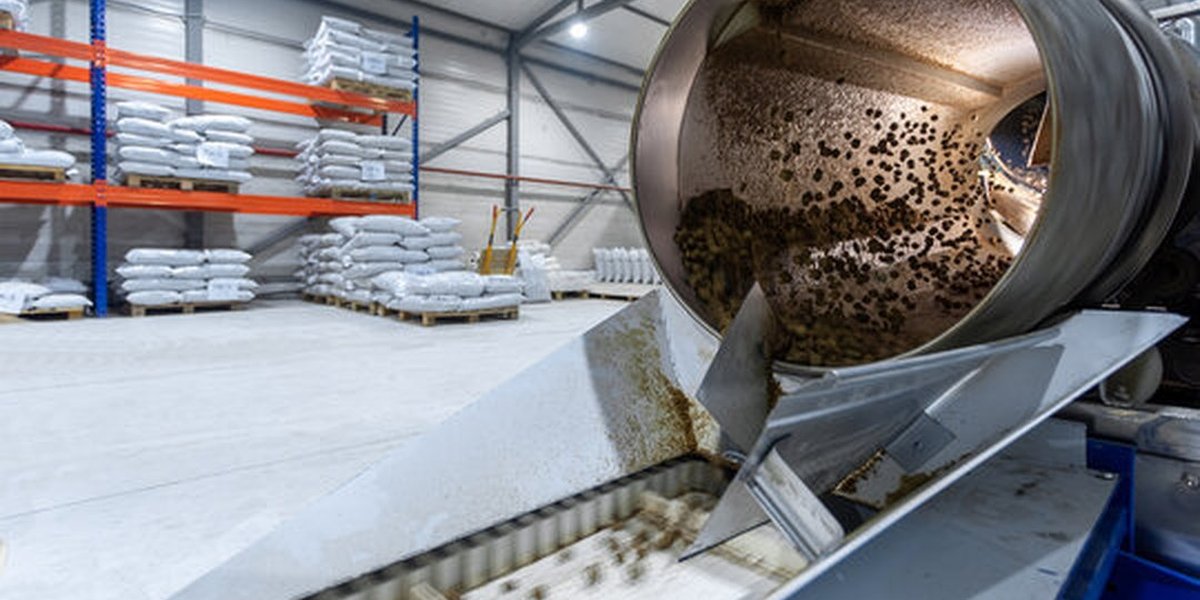
How is dog food made? Dry dog food is made by extrusion. The ingredients are ground and mixed into a mash, preconditioned with steam and water, then cooked in a screw extruder under heat, pressure and shear. The hot dough expands as it leaves the die, is cut into kibble, dried to below 10% moisture, coated with fat and palatant, cooled and packed 1.
A kibble’s texture, digestibility and safety are decided inside the barrel in under a minute, which is why the process settings matter as much as the recipe.
02The process, step by step
The same steps apply to puppy, adult and cat kibble; what changes is the setting at each step.
- 1 · GrindHammer mill, fine and even particles
- 2 · Mix and doseDry blend plus premix; liquids added later
- 3 · PreconditionSteam and water start the starch cook
- 4 · ExtrudeHeat, pressure and shear; the kill step
- 5 · Die and cutExpansion at the die face, knives set length
- 6 · DryHot air to below 10% moisture
- 7 · CoatFat, palatant and heat-sensitive ingredients
- 8 · Cool, screen, packNear ambient, fines removed, barrier bag
If bulk density or moisture drifts out of specification, adjust moisture, steam or screw speed at the extruder and re-check. Typical ranges below are from published process descriptions 1 and our pilot work.
- Grinding. Cereals, legumes, meat meals and other dry ingredients are ground in a hammer mill. For pet food, a final grind through a screen with about 1.2 mm openings is typical, and for small dies the largest particle should be no more than a third of the die opening 1. Fine, even particles hydrate faster and cook more evenly; coarse ones give rough surfaces, weak kibble and die blockages.
- Mixing and dosing. The ground blend is mixed with the vitamin-mineral premix. Fresh meat, slurries and part of the fat are dosed later as liquids. Fat inside the mash lubricates the barrel and cuts expansion: bulk density rises with each point of fat above about 12%, and durability is hard to hold above 22% total fat 1. So most of the fat goes on after drying.
- Preconditioning. In the preconditioner the mash is mixed with steam and water, typically to 10–25% moisture and 70–90 °C at discharge, with most of the cook in the first two minutes 1. It starts starch gelatinisation and reduces the mechanical energy the extruder must add 1.
- Extrusion cooking. Rotating screws convey, compress and shear the mash. Before the die, product temperature typically reaches 125–150 °C under pressure, and most pet foods run best at 23–28% moisture in the barrel 1. The starch gelatinises into a melt that binds protein, fibre and minerals. Most pet food lines use single-screw extruders 1. Twin-screw machines are often preferred for high-meat recipes, though single-screw makers dispute how large that advantage is 12.
- Die and cutting. As pressure drops at the die face, superheated water flashes to steam and the kibble expands. Die open area and shape, and knife speed, set its size and part of its expansion.
- Drying. Hot air, typically 90–180 °C, dries the kibble to below 10% moisture. Below a water activity of about 0.65 bacteria are not a problem, and below about 0.6 moulds are prevented 1. Under-drying risks mould; over-drying wastes energy and yield and makes kibble brittle.
- Coating. In a coating drum or vacuum coater the dried kibble receives fat, palatant and heat-sensitive ingredients. Once more than about 5–8% fat goes on as a coating, a separate cooler is needed 1. Vacuum coating draws fat into the kibble’s pores, allowing more fat without a greasy surface. Palatant choice and rate drive acceptance, as our palatants review shows.
- Cooling, screening and packing. Kibble is cooled close to ambient so condensation cannot form in the bag, screened to remove fines and oversize pieces, then packed, ideally in barrier packaging that slows fat oxidation.
03What happens to the nutrients
Extrusion is why dogs and cats can use starch from grains and legumes: raw starch granules resist digestion, gelatinised starch does not. In a large-scale dog kibble trial, lowering screw speed, and so mechanical energy, reduced starch gelatinisation and increased resistant starch 4. So the process, not only the recipe, sets the carbohydrate a pet absorbs. Starch is not declared on labels, and in 20 commercial dry foods total starch ranged from 16.2% to 37.5% as fed 3.
The same heat drives the Maillard reaction between reducing sugars and amino acids. It adds colour and aroma but lowers reactive lysine, the form the animal can use 5. Extrusion also destroys part of the most sensitive vitamins: A and E among the fat-soluble vitamins, and C, thiamin and folic acid among the water-soluble ones 6. Formulators cover these losses with overages and confirm them by analysis, as our guide to formulating a complete and balanced dog food explains.
04Worked numbers: the process-variable table
Table 1 is the table our process scientists use at the bench. It shows what each lever does when you raise it, with everything else held constant. Effects interact, so change one lever at a time and measure bulk density, moisture and kibble size after each move.
| Raise this | Starch cook | Expansion and bulk density | Kibble texture | Watch out for |
|---|---|---|---|---|
| Preconditioner steam | ↑ | Expansion ↑, density ↓ | Lighter, crisper | Less SME needed; check condensate |
| Extruder water | ↓ shear, cook may fall | Expansion ↓, density ↑ | Denser, harder | Higher dryer load |
| Screw speed | ↑ (more SME) | Expansion ↑, density ↓ | Lighter, more fragile | More fines; motor load |
| Internal fat in mash | ↓ | Expansion ↓, density ↑ | Denser | Keep it low; coat the rest |
| Fibre or fresh meat | ↓ | Expansion ↓, density ↑ | Denser, rougher | Twin screw handles more |
| Die open area | Slight ↓ | Expansion ↓ | Larger, denser piece | Pressure drops; surging |
| Knife speed | No change | No change | Shorter pieces | Size uniformity |
| Dryer temperature or time | No change | Small density ↑ | Harder, more brittle | Over-drying cuts yield |
Table 1. Directional effects for a typical single-screw dog food recipe, from published process descriptions 1 and Guires PNL pilot-plant experience. Magnitudes vary with recipe and equipment.
Calculating specific mechanical energy (SME)
SME is the mechanical energy the screws put into each tonne of product. It is the most useful single number for comparing runs and for moving a process between machines.
When a kibble moves to a larger extruder, matching SME, with matched moisture and steam, is the starting point for matching bulk density and starch cook.
Moisture balance across the dryer
| Stream | Mass (kg/h) | Moisture | Dry solids (kg/h) |
|---|---|---|---|
| Wet kibble into the dryer | 1,000 | 24% | 760 |
| Dried kibble out | 835 | 9% | 760 |
| Water to remove | 165 | – | – |
Table 2. Dry solids are conserved: 760 ÷ 0.91 = 835 kg/h out, so the dryer must evaporate 165 kg of water an hour. Calculated for illustration; not laboratory results.
Every extra point of moisture at the die adds dryer load. If bulk density is on target only at high extruder water, it is usually cheaper to raise preconditioner steam and screw speed than to dry off the extra water.
05Common failure points at scale-up
What we see most often
- Bulk density drifts. Usual causes are variable raw-material moisture, a change in fat or fibre, or worn screws and dies.
- Under-cooked starch. Low preconditioner temperature, short retention or too little SME leaves starch partly raw. Dogs digest less of it and stools soften.
- Recontamination after the kill step. The extruder kills vegetative pathogens, but Salmonella can return through dust, equipment surfaces or coating fat. In a risk model of dry pet food, exposure rose considerably when recontamination happened during fat coating 2, which is why hygienic zoning matters as much as barrel temperature.
- Rancid surface fat. Coating fat high in unsaturated fatty acids oxidises unless it is protected with antioxidants and barrier packaging.
- Moisture too high. Kibble packed warm or too moist can grow mould in the bag. Validate dryer and cooler profiles at full line speed, not only at pilot scale.
- Losses not built into the formula. A recipe that meets its vitamin and amino acid targets on paper can fall short after extrusion and storage. Analyse the finished food, not just the mash.
06Standards that apply: EU, US and India
Process standards set how safely the food is made; nutrient standards set what it must contain.
| Market | Standard | What it sets for kibble |
|---|---|---|
| EU and UK | Regulation (EU) No 142/2011, Annex XIII 7; FEDIAF Nutritional Guidelines 2025 8 | Non-canned processed pet food must be heat-treated to at least 90 °C throughout the final product, or made from animal-origin ingredients already treated to that standard 7. FEDIAF sets nutrient minimums and maximums 8. |
| US | 21 CFR Part 507 9; AAFCO Dog and Cat Food Nutrient Profiles 10 | A written food safety plan with hazard analysis and preventive controls, including process controls such as the extrusion kill step. AAFCO profiles back the “complete and balanced” claim. |
| India | IS 11968:2019, Pet food for dogs and cats 11 | Requirements, sampling and test methods for complete pet food for dogs and cats. |
A process that meets the EU heat-treatment rule is not automatically validated under US preventive controls, which expect evidence that the time and temperature in your own extruder deliver the required pathogen reduction. For export, we validate against the stricter requirement and keep one file per market.
A kibble is right when its bulk density, moisture, starch cook and nutrient profile all hold at full line speed and at the end of shelf life, not when the first pilot bag looks good.
07For brands and formulators
Most dog food brands do not own an extruder, and the gap between a recipe on paper and a kibble that runs well at a co-manufacturer is where launches stall. Our dry pet food development team closes that gap.
08Questions brands ask
How is dry dog food made?
Ingredients are ground, mixed and preconditioned with steam and water, then cooked in an extruder under heat, pressure and shear. The dough expands through a die, is cut into kibble, dried to below 10% moisture, coated with fat and palatant, cooled and packed.
What is the difference between single-screw and twin-screw extrusion?
Most pet food runs on single-screw extruders, which are simpler and cheaper. Twin-screw machines mix more positively and are often preferred for high-meat recipes, at a higher capital and running cost; single-screw makers dispute how large that advantage is.
Does extrusion destroy nutrients in dog food?
It reduces some vitamins, notably A, E, C, thiamin and folic acid, and lowers reactive lysine. It also makes starch digestible and kills pathogens. Formulators add overages for heat-sensitive nutrients and confirm the finished food by analysis.
Is extruded kibble safe from Salmonella?
A validated extrusion step kills vegetative pathogens such as Salmonella. Safety then depends on preventing recontamination during drying, coating, cooling and packing, so hygienic zoning and environmental monitoring are essential.
Sources
- Rokey GJ, Plattner B, Souza EM (2010). Feed extrusion process description. Revista Brasileira de Zootecnia 39 (suppl.):510–518. Source ↗
- Lambertini E, Buchanan RL, Narrod C, Ford RM, Baker RC, Pradhan AK (2016). Quantitative assessment of human and pet exposure to Salmonella associated with dry pet foods. International Journal of Food Microbiology 216:79–90. Source ↗
- Corsato Alvarenga I, Aldrich CG (2020). Starch characterization of commercial extruded dry pet foods. Translational Animal Science 4(2):1017–1022. Source ↗
- Corsato Alvarenga I, Keller LC, Waldy C, Aldrich CG (2021). Extrusion processing modifications of a dog kibble at large scale alter levels of starch available to animal enzymatic digestion. Foods 10(11):2526. Source ↗
- Tran QD, Hendriks WH, van der Poel AFB (2008). Effects of extrusion processing on nutrients in dry pet food. Journal of the Science of Food and Agriculture 88(9):1487–1493. Source ↗
- Riaz MN, Asif M, Ali R (2009). Stability of vitamins during extrusion. Critical Reviews in Food Science and Nutrition 49(4):361–368. Source ↗
- Commission Regulation (EU) No 142/2011, Annex XIII, Chapter II (processed petfood). Source ↗
- FEDIAF (2025). Nutritional Guidelines for Complete and Complementary Pet Food for Cats and Dogs. Source ↗
- US FDA. 21 CFR Part 507: Current Good Manufacturing Practice, Hazard Analysis, and Risk-Based Preventive Controls for Food for Animals. Source ↗
- AAFCO (2014). Revised AAFCO Dog and Cat Food Nutrient Profiles. Pet Food Committee Report, Appendix A. Source ↗
- Bureau of Indian Standards (2019). IS 11968:2019 Pet food for dogs and cats: specification (first revision). Source ↗
- Petfood Industry. The challenges of extruding high-meat pet food. Source ↗
Evidence reviewed by the Guires Pet Nutrition Lab scientific team. This article is general information for product developers and is not legal or veterinary advice.
How to cite this article
Choose your referencing style, then copy. Check your university’s, journal’s or regulator’s guide for local variations.
Mehta, P. (2026, October 31). How kibble is made: extrusion science from mash to bag. Guires Pet Nutrition Lab Insights. https://www.petnutritionlab.com/insights/how-is-kibble-made
Mehta, Priya. “How kibble is made: extrusion science from mash to bag.” Guires Pet Nutrition Lab Insights, 31 Oct. 2026, www.petnutritionlab.com/insights/how-is-kibble-made. Accessed [date].
Mehta, P. (2026) How kibble is made: extrusion science from mash to bag. Available at: https://www.petnutritionlab.com/insights/how-is-kibble-made (Accessed: [date accessed]).
Mehta, Priya. “How kibble is made: extrusion science from mash to bag.” Guires Pet Nutrition Lab Insights. October 31, 2026. https://www.petnutritionlab.com/insights/how-is-kibble-made.
Priya Mehta, ‘How kibble is made: extrusion science from mash to bag’, Guires Pet Nutrition Lab Insights, 31 October 2026, <https://www.petnutritionlab.com/insights/how-is-kibble-made>, accessed [date accessed].
Mehta P. How kibble is made: extrusion science from mash to bag [Internet]. Guires Pet Nutrition Lab Insights; 2026 Oct 31 [cited [date]]. Available from: https://www.petnutritionlab.com/insights/how-is-kibble-made
P. Mehta, “How kibble is made: extrusion science from mash to bag,” Guires Pet Nutrition Lab Insights, Oct. 31, 2026. [Online]. Available: https://www.petnutritionlab.com/insights/how-is-kibble-made
@misc{guirespnl2026howiskibblemade,
  author = {Mehta, Priya},
  title = {{How kibble is made: extrusion science from mash to bag}},
  year = {2026},
  month = oct,
  howpublished = {\url{https://www.petnutritionlab.com/insights/how-is-kibble-made}},
  note = {Guires Pet Nutrition Lab Insights}
}
This article summarises published evidence for product developers. Cite the original sources above for specific findings, and do not reproduce this article as your own work.
Moving a kibble from recipe to production line?
Tell us the species, life stage, kibble size and target market. We formulate for your extruder, run pilot trials to lock bulk density and texture, and validate the kill step and shelf life.