Chicken meal vs fresh chicken: what the ingredient list does not tell you
Why “chicken” listed first can supply less protein than chicken meal listed third, with the dry-matter maths, the quality trade-offs and what to specify.
- Ingredients are listed by weight as they go into the recipe, water included.
- Fresh chicken is about two-thirds water; chicken meal is about 10%, so less meal can supply more protein.
- On a dry-matter basis skinless chicken meat is the most protein-dense; meal is diluted by bone and fat.
- Specify both: protein, ash, fat, peroxide value and digestibility for meal; moisture, fat and bone for fresh chicken.
01The short answer
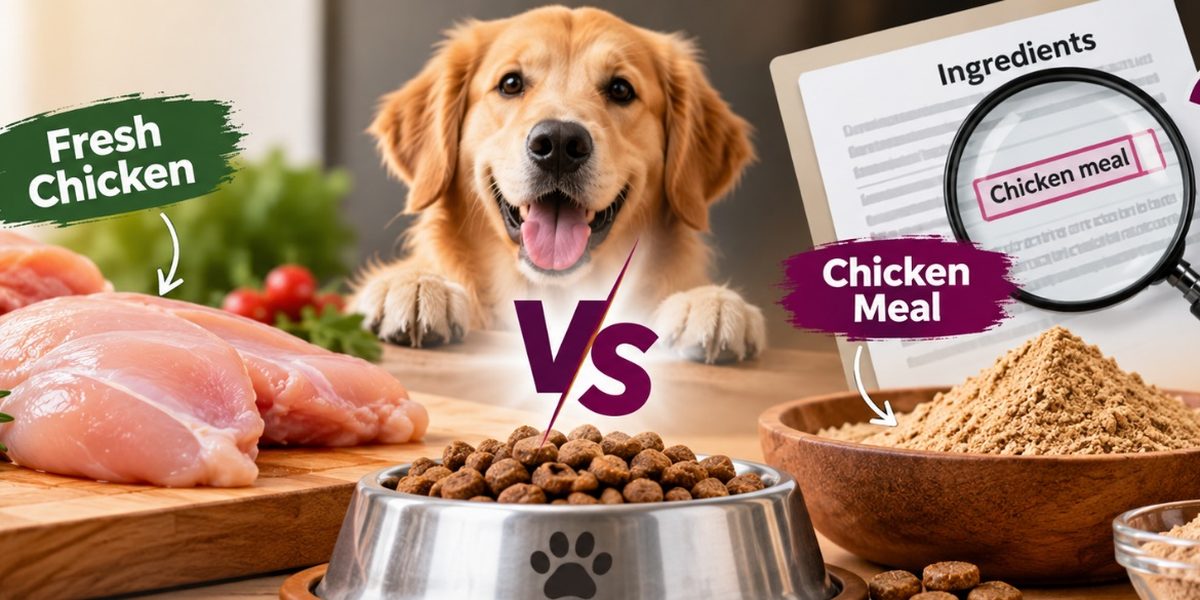
Can “chicken” listed first on a dry dog food label deliver less protein than “chicken meal” listed third? Often, yes, and the reason is water, not meat quality. Ingredients are declared in descending order of weight as they go into the recipe 1, and that weight includes water. Raw chicken meat and skin is about 66% water; chicken meal is about 10% 4,3. Once extrusion drives the water off, a smaller inclusion of chicken meal can supply far more protein than a larger inclusion of fresh chicken.
Neither ingredient is automatically better. Each brings trade-offs in digestibility, ash, oxidation and supply that a formulator has to manage, and the label has to tell the same story as the formula.
02What chicken meal is
In the AAFCO ingredient definitions, chicken is the clean combination of flesh and skin, with or without accompanying bone, from whole carcasses or parts, excluding feathers, heads, feet and entrails. Chicken meal is the same material dry-rendered: cooked, with much of the fat and water removed, then dried and ground into a concentrated protein ingredient. Chicken by-product meal is a different ingredient; it can include necks, feet, undeveloped eggs and intestines 1.
So chicken meal is not a lower grade of raw material than chicken. It is the same raw material with the water taken out before it reaches the pet food plant.
03Side by side
| Attribute | Fresh chicken (meat and skin) | Chicken meal |
|---|---|---|
| Moisture | 66% | About 10% |
| Crude protein, as fed | 18.6% | About 65% |
| Protein, dry-matter basis | About 55% | About 72% |
| Fat | 15% | About 15% remaining after rendering |
| Ash | Under 1% without bone | Under 14% in pet food grade; under 11% in low-ash grades |
| Handling | Cold chain; pumped as a slurry | Shelf-stable powder; needs an antioxidant |
| Label appeal | High (“real chicken first”) | Lower with some shoppers |
Fresh chicken values from USDA FoodData Central 4; chicken meal fat and ash from Aldrich (2007) 3; meal moisture and protein are typical values. Always formulate from your supplier’s certificate of analysis (COA).
04The dry-matter maths
Take 100 g of each ingredient.
- Fresh chicken, meat and skin: 66 g water and 18.6 g protein. Dry matter is 34 g, so protein is 18.6 ÷ 34 = 55% on a dry-matter basis.
- Skinless chicken meat: 75.5 g water and 21.4 g protein. Dry matter is 24.5 g, so protein is 87% on a dry-matter basis 4.
- Chicken meal: 10 g water and 65 g protein. Dry matter is 90 g, so protein is 65 ÷ 90 = 72% on a dry-matter basis.
Calculated by Guires PNL from USDA values for raw chicken 4 and a typical chicken meal at 65% protein and 10% moisture. Bars are scaled to 100.
View data table
| Ingredient | Protein as fed (g/100 g) | Protein, dry matter (%) |
|---|---|---|
| Chicken meat and skin | 18.6 | 55 |
| Skinless chicken meat | 21.4 | 87 |
| Chicken meal | 65 | 72 |
As fed, 100 g of chicken meal delivers about 3.5 times the protein of 100 g of fresh chicken meat and skin. On a dry-matter basis, though, skinless chicken meat is the most protein-dense of the three; meal is diluted by the bone and fat it carries.
05What it means in a recipe
Consider a dry dog food with 25% fresh chicken and 12% chicken meal in the mix before extrusion. Fresh chicken contributes 25 × 0.186 = 4.7 g of protein per 100 g of mix; chicken meal contributes 12 × 0.65 = 7.8 g.
Worked example by Guires PNL; inclusion rates are illustrative.
The label reads “chicken” first, yet the meal supplies about two-thirds more protein. After drying, the 25 g of fresh chicken leaves only about 8.5 g of solids, less than the 10.8 g of solids in the meal. Add ingredient splitting (listing peas, pea protein and pea flour separately so that each falls lower) and the first words of a label can say more about marketing than nutrition.
That is why many formulators use both. Fresh chicken lifts palatability and label appeal; chicken meal carries the protein density needed to meet amino acid targets without overloading the extruder with water.
06Digestibility, ash, oxidation and supply
- Digestibility. Rendering uses sustained heat. In one dog study, ileal digestibility of all amino acids except cystine was higher for fresh poultry than for poultry by-product meal, although total-tract digestibility did not differ, and rendering beef showed no such effect 2. Meal quality varies with raw material and rendering conditions.
- Ash. Bone raises ash, calcium and phosphorus. High-ash meals dilute energy density and can push the calcium-to-phosphorus ratio out of range, especially in large-breed puppy foods; see our calcium and phosphorus guide.
- Oxidation. The fat left in a meal oxidises over time. Suppliers stabilise it with antioxidants such as mixed tocopherols, and buyers should set peroxide value limits.
- Consistency. Fresh chicken varies in fat and bone; meal varies in protein, ash and digestibility between plants and lots.
07For brands and formulators
Ingredient selection and label strategy should be decided together, not one after the other.
What to specify
- Formulate on a dry-matter and energy basis against the AAFCO or FEDIAF profile 5, then check that the label order still tells an honest story.
- For meals, set limits on protein, moisture, fat, ash, peroxide value and pepsin digestibility, and name the antioxidant.
- For fresh chicken, specify moisture, fat and bone content, temperature on receipt and microbiological criteria.
- Know the naming rules: the 95%, 25% (“dinner”), 3% (“with”) and flavour rules decide what a product name can claim 1.
- Plan supply: meal simplifies storage and logistics, while fresh chicken needs cold-chain capacity at the plant.
The full method is in our hub guide, how to formulate a complete and balanced dog food. For supplier specifications, see sourcing and procurement; before print, a label review checks that the name and ingredient list match the formula.
Judge chicken and chicken meal by the protein they leave in the dried food, not by their place on the label.
08Questions brands ask
Is chicken meal in dog food a poor-quality ingredient?
No. It is a concentrated, cost-effective protein source made from the same raw material as chicken. Its quality depends on the raw material, rendering conditions and the supplier’s specification.
Is chicken meal the same as chicken by-product meal?
No. Chicken meal is rendered flesh and skin, with or without bone. Chicken by-product meal can also include necks, feet, undeveloped eggs and intestines.
Why does fresh chicken appear first on the label?
Ingredients are listed by weight as they go into the recipe. Water makes fresh chicken heavy in the mix, even though most of that weight leaves during extrusion.
Should a dry dog food use chicken, chicken meal or both?
Many use both: fresh chicken for palatability and label appeal, chicken meal for protein density. The right balance depends on the protein target, extruder capacity, cost and the claim on the pack.
Sources
- AAFCO. Official Publication: ingredient definitions (chicken, chicken meal, chicken by-product meal) and pet food naming rules; see also AAFCO, How to understand a dog or cat food label. Source ↗
- Murray SM, Patil AR, Fahey GC Jr et al. (1997). Raw and rendered animal by-products as ingredients in dog diets. Journal of Animal Science 75(9):2497–2505. Source ↗
- Aldrich G (2007). Poultry meal in pet foods. Engormix, courtesy of Alltech. Source ↗
- US Department of Agriculture. FoodData Central, SR Legacy: chicken, broilers or fryers, meat and skin, raw (171447); meat only, raw (171052). Source ↗
- AAFCO (2014). Revised AAFCO Dog and Cat Food Nutrient Profiles. Pet Food Committee Report, Appendix A. Source ↗
Evidence reviewed by the Guires Pet Nutrition Lab scientific team. This article is general information for product developers and is not legal or veterinary advice.
How to cite this article
Choose your referencing style, then copy. Check your university’s, journal’s or regulator’s guide for local variations.
Mehta, P. (2026, October 20). Chicken meal vs fresh chicken: what the ingredient list does not tell you. Guires Pet Nutrition Lab Insights. https://www.petnutritionlab.com/insights/chicken-meal-vs-chicken
Mehta, Priya. “Chicken meal vs fresh chicken: what the ingredient list does not tell you.” Guires Pet Nutrition Lab Insights, 20 Oct. 2026, www.petnutritionlab.com/insights/chicken-meal-vs-chicken. Accessed [date].
Mehta, P. (2026) Chicken meal vs fresh chicken: what the ingredient list does not tell you. Available at: https://www.petnutritionlab.com/insights/chicken-meal-vs-chicken (Accessed: [date accessed]).
Mehta, Priya. “Chicken meal vs fresh chicken: what the ingredient list does not tell you.” Guires Pet Nutrition Lab Insights. October 20, 2026. https://www.petnutritionlab.com/insights/chicken-meal-vs-chicken.
Priya Mehta, ‘Chicken meal vs fresh chicken: what the ingredient list does not tell you’, Guires Pet Nutrition Lab Insights, 20 October 2026, <https://www.petnutritionlab.com/insights/chicken-meal-vs-chicken>, accessed [date accessed].
Mehta P. Chicken meal vs fresh chicken: what the ingredient list does not tell you [Internet]. Guires Pet Nutrition Lab Insights; 2026 Oct 20 [cited [date]]. Available from: https://www.petnutritionlab.com/insights/chicken-meal-vs-chicken
P. Mehta, “Chicken meal vs fresh chicken: what the ingredient list does not tell you,” Guires Pet Nutrition Lab Insights, Oct. 20, 2026. [Online]. Available: https://www.petnutritionlab.com/insights/chicken-meal-vs-chicken
@misc{guirespnl2026chickenmealvschicken,
  author = {Mehta, Priya},
  title = {{Chicken meal vs fresh chicken: what the ingredient list does not tell you}},
  year = {2026},
  month = oct,
  howpublished = {\url{https://www.petnutritionlab.com/insights/chicken-meal-vs-chicken}},
  note = {Guires Pet Nutrition Lab Insights}
}
This article summarises published evidence for product developers. Cite the original sources above for specific findings, and do not reproduce this article as your own work.
Choosing proteins for a new dry food?
We model chicken, chicken meal and other proteins on a dry-matter and energy basis, set supplier specifications and check that the label tells the same story as the formula.