Starch in kibble: rice, corn, pea and tapioca compared
All four cook into digestible starch, but they expand, bind and raise blood glucose differently. What each brings to a dry dog food, and how to choose between them.
- All four starches are over 98% digestible once extruded; brewers rice and cassava gave the highest overall diet digestibility in dogs.
- Rice, corn and cassava raise glucose and insulin faster in the first 30 minutes; pea and lentil diets give later responses.
- More amylopectin means more expansion; pea, highest in amylose, tends to give denser kibble.
- Corn is a minor food allergen in dogs (4% of 297 cases); pulses need care because of the FDA DCM reports.
01Why the starch source matters
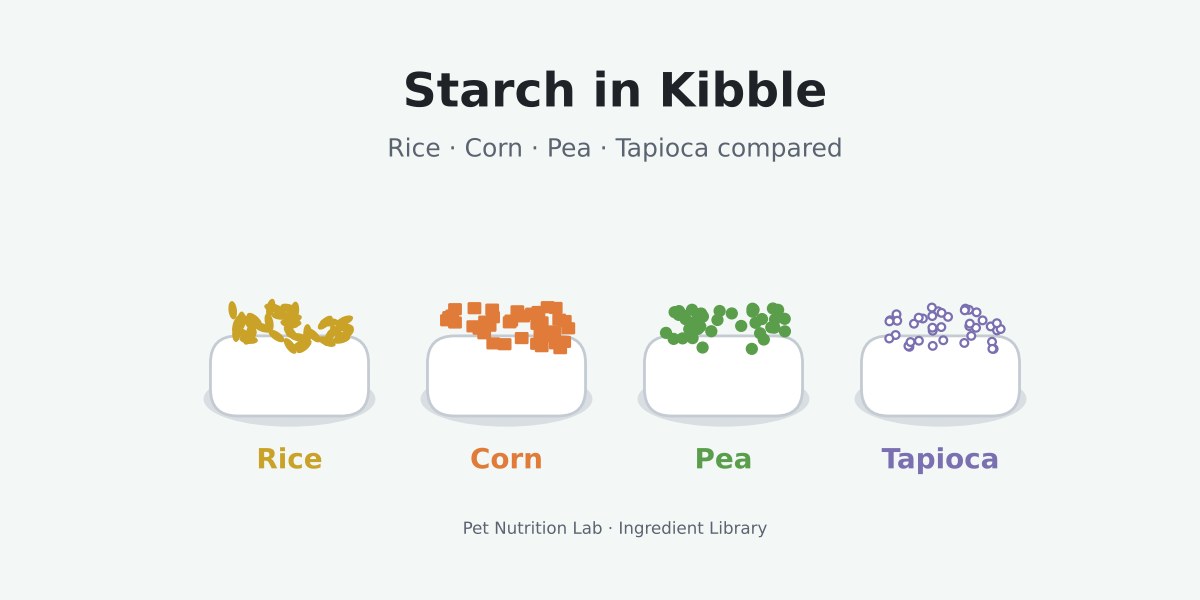
Rice in dog food sits alongside corn, pea and tapioca as one of the main starch sources in kibble. All four deliver digestible starch once extruded, but they differ in amylose content, fibre, protein and glycaemic response. Those differences change how the kibble expands, how firm it is, and how the dog’s blood glucose responds after a meal. So “is rice good for dogs?” is really a question about which starch suits which recipe.
For the full process, see our guide to how kibble is made.
02Forms used in pet food
Each starch reaches the extruder in several forms, and the form decides how much protein and fibre come with it.
| Source | Common forms in kibble | Amylose, % of starch (typical) | What else it brings | Extrusion behaviour |
|---|---|---|---|---|
| Rice | Brewers rice, white rice, brown rice, rice flour | Varies widely by variety | White rice: little fibre. Brown rice: more fibre and B vitamins | Expands well, smooth uniform texture |
| Corn (maize) | Ground corn, corn meal; corn gluten meal is the protein fraction | 20–28, typical 25 2 | Linoleic acid, some protein, carotenoids | Reliable expansion, easy to run |
| Pea | Whole pea, pea flour, pea starch, pea protein, pea fibre | 24–49, typical 35 24 | Protein and fibre (whole pea, flour) | Denser, firmer kibble, less expansion |
| Tapioca (cassava) | Cassava flour, tapioca starch | 17 4 to 24–26 2 | Almost pure starch; very little protein or fibre | High expansion; risk of fragile kibble and fines |
Table 1. Amylose ranges from ADM and Pet Food Processing, which differ for tapioca; extrusion behaviour from our pilot experience. Check supplier specifications for each lot.
03Function in the recipe
Starch is the structural backbone of an extruded kibble. In the barrel, heat, moisture and shear swell and rupture the starch granules. The gelatinised starch gives the melt a stretchy, gas-holding structure, much as gluten does in bread dough, so the kibble puffs as it leaves the die 3.
- MashRaw granules, poorly digestible
- PreconditionerSteam and water: granules hydrate and swell
- Extruder barrelHeat and shear: granules rupture and gelatinise
- DieWater flashes to steam: the melt expands
- Dryer and coolerStructure sets; starch stays cooked
The amylose:amylopectin ratio steers that behaviour:
- More amylopectin (tapioca, waxy types) gives greater kibble expansion, but can increase fines 2.
- More amylose (pea) leaves less of the expanding fraction, and in our experience gives a denser, firmer kibble.
- Blends let formulators tune bulk density, hardness and shape stability. A star-shaped kibble, for example, needs more binding than a cylinder.
Ranges from ADM 2 and Pet Food Processing 4; bars scaled to 50%. Neither source gives a figure for rice, whose amylose varies widely by variety, so it is not plotted.
View data table
| Source | Amylose, % of starch | Typical |
|---|---|---|
| Tapioca / cassava | 17 (PFP); 24–26 (ADM) | 17–25 |
| Corn | 20–28 | 25 |
| Yellow pea | 24–49 | 35 |
Total starch matters too. Cat, puppy and high-meat foods typically run near 30% starch and other adult dog foods nearer 40%; as meat and fat rise, very little expansion is possible 3.
04Digestibility and glucose response
All four starches are well digested once properly extruded. In a controlled study, 36 dogs were fed six extruded diets based on cassava flour, brewers rice, corn, sorghum, peas or lentils. Starch digestibility exceeded 98% on every diet. Brewers rice and cassava gave the highest dry matter and energy digestibility, corn and sorghum came next, and peas and lentils the lowest 1.
The glucose picture differed. Rice, corn and cassava produced larger glucose and insulin responses in the first 30 minutes, while sorghum, lentil and pea diets produced larger responses later. The authors linked this to fibre content and starch granule structure 1. Cats responded less than dogs: only the corn diet lifted glucose above baseline, at 4 and 10 hours after the meal 7.
| Diet starch source | Glucose and insulin response | Diet digestibility (DM, energy) |
|---|---|---|
| Brewers rice, cassava | Larger in the first 30 minutes | Highest |
| Corn | Larger in the first 30 minutes | Intermediate |
| Sorghum | Larger after 30 minutes | Intermediate |
| Peas, lentils | Larger after 30 minutes | Lowest |
Table 2. Six extruded diets fed to 36 dogs, from Carciofi et al. 1. Starch digestibility exceeded 98% on every diet.
Is rice good for dogs?
Yes, as a carbohydrate source. Cooked white rice is highly digestible and low in fibre, which is why vets use it in bland diets for an upset stomach. Brown rice adds fibre. Rice does not supply complete protein or a full set of amino acids, so it belongs inside a complete and balanced diet, not in place of one.
Is corn bad for dogs?
The evidence does not support that claim. Extruded corn is well digested 1, and corn is a minor food allergen in dogs: of 297 dogs with adverse food reactions, 34% reacted to beef, 17% to dairy, 15% to chicken and 13% to wheat, against 4% to corn 6. Its faster glucose response is a formulation consideration, mainly for diabetic or weight-control recipes.
Pea starch and grain-free formulation
Peas let brands make grain-free claims and add protein and fibre. But 93% of the products named in FDA’s canine dilated cardiomyopathy (DCM) reports contained peas and/or lentils, and more than 90% were grain-free. FDA did not establish a cause 5. Read our review of the grain-free and DCM evidence before setting pulse inclusion levels.
05Regulatory status
Rice, maize, peas and manioc (tapioca, cassava) are feed materials, not additives, so no EU additive authorisation or maximum applies. They are listed in the EU Catalogue of feed materials, which sets their names and, for some processed entries such as broken rice, maize flakes, pea flakes and dried manioc, a compulsory starch declaration 8. Neither FEDIAF nor AAFCO sets a starch minimum for adult dogs, and no minimum carbohydrate requirement has been established 910. In practice starch inclusion is limited by meeting the protein, fat and micronutrient targets. In the US, ingredient names must follow AAFCO definitions.
06Quality specifications and tests
Specify and test each starch lot on
- Total starch and amylose content, which predict expansion and binding 2.
- Moisture, crude protein, crude fibre and ash, for an accurate nutrient matrix.
- Particle size, since coarse grinds gelatinise unevenly.
- Mycotoxins, especially aflatoxins and fumonisins in corn.
- Degree of gelatinisation in the finished kibble, the main check that the starch is cooked and digestible.
- Kibble metrics: bulk density, expansion ratio, hardness and fines.
Sourcing notes
- Rice: brewers rice (broken kernels) is cost-effective and consistent; keep arsenic on the contaminant panel.
- Corn: widely available and low cost; mycotoxin risk varies by crop year and origin.
- Pea: supply follows pulse harvests; protein and fibre differ between whole pea and its fractions.
- Tapioca: mostly imported from Southeast Asia; check cassava flour for residual cyanogenic compounds.
07For brands and formulators
Choosing a starch is a trade-off between kibble quality, glycaemic response, label claims and cost. A switch from corn to pea, or from rice to tapioca, changes density, hardness and digestibility, and usually needs new extrusion settings.
No single starch is best. Choose rice, corn, pea or tapioca for the kibble structure, glucose response and label claim you need, then confirm the cook and digestibility in the finished kibble.
08Questions brands ask
Is rice good for dogs?
Yes, as a carbohydrate source. Extruded brewers rice is highly digestible, and cooked white rice is used in bland diets. Rice does not supply complete protein, so it belongs inside a complete and balanced diet.
Is corn bad for dogs?
The evidence does not support that. Extruded corn is well digested, and corn caused 4% of reported food reactions in dogs against 34% for beef. Its faster glucose response matters mainly in diabetic or weight-control recipes.
Which starch gives the most kibble expansion?
Starches higher in amylopectin, such as tapioca, expand more but can raise fines. Pea, highest in amylose of the four, tends to give a denser, firmer kibble. Blends let formulators tune density and hardness.
Is pea starch safe in grain-free dog food?
Pea starch is well digested, but 93% of products in FDA’s DCM reports contained peas and/or lentils. FDA did not establish a cause, so review the evidence before setting high pulse inclusions.
Sources
- Carciofi AC, Takakura FS, de-Oliveira LD, et al. (2008). Effects of six carbohydrate sources on dog diet digestibility and post-prandial glucose and insulin response. Journal of Animal Physiology and Animal Nutrition 92(3):326–336. Source ↗
- ADM Animal Nutrition (2021). Amylose and amylopectin: understanding starch from the inside out [white paper]. Source ↗
- Ward L (2024). Formulation requirements on moisture and starch for extrusion. GlobalPETS. Source ↗
- Pet Food Processing. Starches provide structural support for pet food, treat formulations. Source ↗
- FDA (27 Jun 2019). FDA provides third status report on investigation into potential connection between certain diets and cases of canine heart disease. Source ↗
- Mueller RS, Olivry T, Prélaud P (2016). Critically appraised topic on adverse food reactions of companion animals (2): common food allergen sources in dogs and cats. BMC Veterinary Research 12:9. Source ↗
- de-Oliveira LD, Carciofi AC, Oliveira MCC, et al. (2008). Effects of six carbohydrate sources on diet digestibility and postprandial glucose and insulin responses in cats. Journal of Animal Science 86(9):2237–2246. Source ↗
- Commission Regulation (EU) No 68/2013 on the Catalogue of feed materials. Source ↗
- FEDIAF (2025). Nutritional Guidelines for Complete and Complementary Pet Food for Cats and Dogs. Source ↗
- Kayser E, Finet S, de Godoy MRC (2024). Dietary carbohydrates in dog and cat nutrition. Animal Frontiers 14(3):28–37. Source ↗
Evidence reviewed by the Guires Pet Nutrition Lab scientific team. This article is general information for product developers and is not legal or veterinary advice.
How to cite this article
Choose your referencing style, then copy. Check your university’s, journal’s or regulator’s guide for local variations.
Mehta, P. (2026, October 31). Starch in kibble: rice, corn, pea and tapioca compared. Guires Pet Nutrition Lab Insights. https://www.petnutritionlab.com/insights/starch-in-kibble
Mehta, Priya. “Starch in kibble: rice, corn, pea and tapioca compared.” Guires Pet Nutrition Lab Insights, 31 Oct. 2026, www.petnutritionlab.com/insights/starch-in-kibble. Accessed [date].
Mehta, P. (2026) Starch in kibble: rice, corn, pea and tapioca compared. Available at: https://www.petnutritionlab.com/insights/starch-in-kibble (Accessed: [date accessed]).
Mehta, Priya. “Starch in kibble: rice, corn, pea and tapioca compared.” Guires Pet Nutrition Lab Insights. October 31, 2026. https://www.petnutritionlab.com/insights/starch-in-kibble.
Priya Mehta, ‘Starch in kibble: rice, corn, pea and tapioca compared’, Guires Pet Nutrition Lab Insights, 31 October 2026, <https://www.petnutritionlab.com/insights/starch-in-kibble>, accessed [date accessed].
Mehta P. Starch in kibble: rice, corn, pea and tapioca compared [Internet]. Guires Pet Nutrition Lab Insights; 2026 Oct 31 [cited [date]]. Available from: https://www.petnutritionlab.com/insights/starch-in-kibble
P. Mehta, “Starch in kibble: rice, corn, pea and tapioca compared,” Guires Pet Nutrition Lab Insights, Oct. 31, 2026. [Online]. Available: https://www.petnutritionlab.com/insights/starch-in-kibble
@misc{guirespnl2026starchinkibble,
  author = {Mehta, Priya},
  title = {{Starch in kibble: rice, corn, pea and tapioca compared}},
  year = {2026},
  month = oct,
  howpublished = {\url{https://www.petnutritionlab.com/insights/starch-in-kibble}},
  note = {Guires Pet Nutrition Lab Insights}
}
This article summarises published evidence for product developers. Cite the original sources above for specific findings, and do not reproduce this article as your own work.
Ready to optimise your kibble recipe?
We select and blend starches for target expansion and texture, check the full nutrient profile, and test gelatinisation and digestibility in the finished kibble.