Single-screw vs twin-screw extruders for pet food: how extrusion choice shapes the formulation
The extruder does not just cook the recipe; it limits what the recipe can be. This guide separates what the studies show from engineering convention, and sets out how to choose.
- Published pet food SME values span about 5 to 85 kWh/t, and each holds only for its own machine, die and recipe.
- In the one head-to-head study, both machine types raised amino acid digestibility, but the result depended on diet; the twin-screw ran at about a fifth of the single-screw’s SME.
- Added fat steadily lowered SME and expansion and raised bulk density on a single-screw line; a high-shear screw only partly offset it.
- Starch source changes kibble density, expansion and hardness, so recipe and screw design are chosen together.
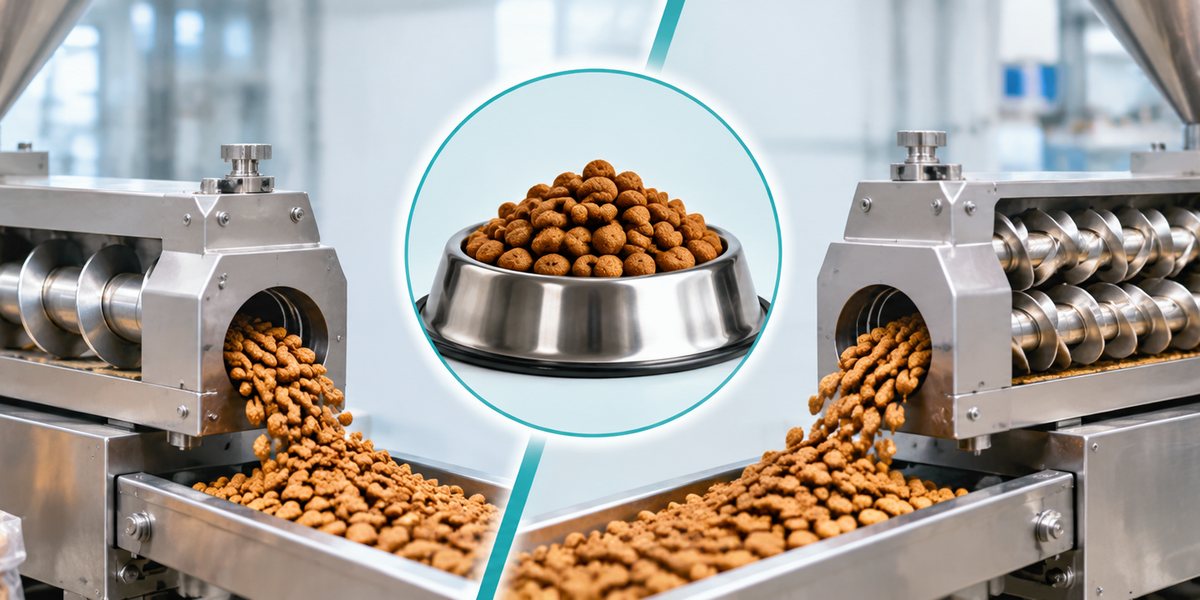
A twin screw extruder conveys and cooks pet food dough with two intermeshing screws. By convention this gives more control of mixing, shear and moisture than a single-screw machine, and suits high-meat, high-fat or high-moisture recipes. Whichever machine is used, it shapes cook, expansion and bulk density, so the formulation has to be built around it 135. Head-to-head data are thin: one 2024 study found both types raised amino acid digestibility, but the size of the gain depended on the diet 2.
01Why extruder choice matters for kibble
Developers weighing a single-screw vs twin-screw extruder ask whether to buy, rent or contract each, and the honest answer depends on the product range. This guide is about that decision, not the basics; for the process from mash to bag, read how kibble is made first.
How extrusion shapes cook, expansion and density
The extruder sets the shear and residence time the dough receives, and these set starch gelatinisation and structure. A 2024 study combined a Beagle trial with a model of published diet data and put the gelatinisation that maximises nutrient digestibility at about 83–87% 3. Expansion and bulk density follow from the same energy input, so the machine, the recipe and the die cannot be chosen separately.
02Single-screw extruders
A single-screw pet food extruder conveys dough mainly by friction against the barrel, which makes it simple, robust and cheaper to buy. It is the most common machine in pet food extrusion 7. Its limits show when the recipe is hard to feed or rich in fat.
- Powder flow. On a single-screw machine (L/D 10:1), insect-meal dog diets ran at 231–307 kJ/kg SME across two experiments. The coefficient of variation of SME, a measure of process stability, was 29–30% for cricket flour and poultry meal diets but 5–6% for black soldier fly larvae and fish meal diets 5. The ingredients, not only the machine, set stability.
- Screw profile. In a fish feed on a single-screw line, adding 0 to 4% fat in the preconditioner steadily lowered SME, gelatinisation and expansion and raised bulk density. A high-shear screw partly offset the loss but could not fully counter 4% fat 4. Read the direction, not the figures, for dog food.
03Twin-screw extruders
In a twin-screw machine the screws convey positively, so feed rate and screw speed depend less on the dough’s friction. By convention this suits high-meat, high-fat or high-moisture recipes and gives narrower control of residence time, at higher purchase and maintenance cost.
The one head-to-head pet food study ran the same eight grain-free diets on a single- and a twin-screw extruder. Both raised amino acid digestibility, measured in a cecectomised rooster assay, compared with the raw ingredients, and neither lowered taurine. The effect depended on diet and machine: in one chicken-slurry diet, lysine digestibility was 0.73 on the twin-screw against 0.84 on the single-screw. The twin-screw also ran at about a fifth of the single-screw’s SME, with more water and the back-pressure valve fully open 2. For a twin screw extruder pet food line, the case rests on flexibility and consistency, not on a proven nutritional advantage.
| Question | Single-screw | Twin-screw |
|---|---|---|
| Protein quality after extrusion | Amino acid digestibility improved 2 | Improved, but lower than single-screw in some diets 2 |
| Published SME | About 12–85 kWh/t across studies 235 | 5–26 kWh/t in one study 2 |
| Sensitivity to added fat | SME and expansion fall steadily as preconditioner fat rises 4 | Convention: less sensitive (not tested) |
| Cost and complexity | Convention: lower | Convention: higher |
Table 1. Single-screw vs twin-screw: what the evidence supports. “Convention” marks engineering practice not tested in the cited studies.
04How the extruder shapes the formulation
Starch, protein, fat and fibre
Seven dog diets that differed only in starch source gave tuber-based kibble with lower density and higher expansion, size and hardness than cereal or pulse diets, while pea reduced expansion 6. Fat reduces dough viscosity and expansion 1 and lowers SME 4, so a high-fat recipe needs a machine and screw profile that still deliver cook. Insect-meal chitin gave elongated, fragile kibble, while about 10% black soldier fly larvae with poultry meal kept the process stable 5.
Specific mechanical energy and moisture
Specific mechanical energy (SME) is the mechanical work put into each tonne of product. Reported pet food values span about 5 to 85 kWh/t (Figure 1), so an SME target is valid only for one machine, die and recipe. Steam and moisture in the preconditioner move the same dials; the fat study’s authors note that more of both reduces the SME needed 47.
Data from 235. Insect-meal values converted by Guires PNL from 231–307 kJ/kg (1 kWh/t = 3.6 kJ/kg). Axis 0–90 kWh/t. These are ranges, not settings.
View data table
| Study | SME (kWh/t) |
|---|---|
| Twin-screw, grain-free diets | 5–26 |
| Single-screw, same diets | 50.8–69.6 |
| Single-screw, starch cook trial | 12–22 |
| Single-screw, insect meals | 64.2–85.2 |
05Choosing an extruder for your product
Four questions before you choose
- Product range. One simple dry recipe points to a single-screw line; many formats or high-meat, high-fat lines may justify a twin-screw.
- Fat and meat level. Fix the maximum internal fat early. In the fish feed study the authors judged quality compromised above 2% added fat on an 8%-fat recipe, about 10–12% total 4.
- Volume and budget. A contract run on a partner’s line is a pilot route before capital spend.
- Evidence of the result. Judge the extruder by kibble quality and finished-diet digestibility, not by the machine type 23.
06Formulating to the extrusion process
Formulate for the machine you will use, and record its settings with the recipe. Run a small trial matrix on SME, moisture and die, measure expansion, bulk density and digestibility, then lock the specification. Our dry pet food service runs this vendor-neutral, and pilot manufacturing proves it before handover. The kibble quality tests guide covers what to measure.
The extruder decision is a choice about flexibility and control, not nutrition. Build the recipe around the machine you will run, and treat any SME figure as meaningful only on its own line.
07Questions developers ask
What is the difference between single-screw and twin-screw extruders in pet food?
A single-screw extruder relies mainly on friction to convey and cook the dough. A twin-screw machine uses two intermeshing screws, which by convention gives better mixing, shear and moisture control, and suits high-fat, high-meat or high-moisture recipes. Single-screw machines are simpler and cost less.
Which extruder is better for pet food?
Neither is better in every case. By convention, a twin-screw machine is chosen for demanding or premium kibble and a single-screw for simpler, high-volume products. In the one head-to-head study, both improved protein quality, with differences that depended on the diet.
How does extrusion affect kibble formulation?
Extrusion cooks starch and sets expansion, bulk density, texture and durability, so the formulation must match the process. Starch, protein, fat and fibre each behave differently in the extruder.
What is specific mechanical energy (SME) in extrusion?
SME is the mechanical work put into each unit of product, usually reported in kWh/t or kJ/kg. It affects cook, expansion and kibble density, and its value is specific to the machine, screw profile, die and recipe.
Specialisation: Extrusion trial design, kibble structure, formulation–process interaction and scale-up.
Read the dry pet food guides in order
- Dry pet food market trends in India · where a new brand fits
- Single-screw vs twin-screw extruders · you are here
- Dry pet food rules in India · IS 11968, FSSAI and import
- Kibble quality tests · bulk density, hardness and fines
- Worked case study · one brief from trials to a QC specification
- Dry pet food product development · how we run it for your product
Sources
- Le Guillas G, Vanacker P, Salles C, Labouré H (2024). Insights to study, understand and manage extruded dry pet food palatability. Animals 14(7):1095. Source ↗
- Hsu C, Utterback PL, Parsons CM, Davenport GM, Rokey G, de Godoy MRC (2024). Effects of single and twin thermal screw extrusion on protein quality of grain-free pet foods formulated with predominantly animal- or plant-based protein ingredients. Animal Feed Science and Technology 313:115999. Source ↗
- Loureiro BA, Oliveira MCC, Peixoto MC, Ribeiro EM, Schauf S, Castrillo C, Carciofi AC (2024). Starch gelatinization implications for nutrient digestibility and fermentation products in the faeces of Beagle dogs. Animal Feed Science and Technology 309:115894. Source ↗
- Scarpim LB, Baller MA, Pacheco LG, Theodoro SS, Carneiro DJ, Carciofi AC (2026). Effects of internal fat content and screw configuration on extrusion traits and kibble characteristics of high-protein, low-starch fish feed. Processes 14(2):310. Source ↗
- Chen Y, Graff T, Cairns AC, Griffin R, Siliveru K, Pezzali JG, Alavi S (2025). Use of insect meals in dry expanded dog food: impact of composition and particulate flow characteristics on extrusion process and kibble properties. Processes 13(7):2083. Source ↗
- Kaelle GCB, Bastos TS, de Souza RBMdS, Fernandes EL, Santos LNA, de Oliveira SG, Félix AP (2024). Starch sources and their influence on extrusion parameters, kibble characteristics and palatability of dog diets. Italian Journal of Animal Science 23(1):388–396. Source ↗
- Rokey GJ, Plattner B, Souza EM (2010). Feed extrusion process description. Revista Brasileira de Zootecnia 39 (suppl.):510–518. Source ↗
Evidence reviewed by the Guires Pet Nutrition Lab scientific team. This article is general information for product developers and is not legal or veterinary advice.
How to cite this article
Choose your referencing style, then copy. Check your university’s, journal’s or regulator’s guide for local variations.
Mehta, R. (2026, November 5). Single-screw vs twin-screw extruders for pet food: how extrusion choice shapes the formulation. Guires Pet Nutrition Lab Insights. https://www.petnutritionlab.com/insights/single-vs-twin-screw-extruder-pet-food-formulation
Mehta, Rohan. “Single-screw vs twin-screw extruders for pet food: how extrusion choice shapes the formulation.” Guires Pet Nutrition Lab Insights, 5 Nov. 2026, www.petnutritionlab.com/insights/single-vs-twin-screw-extruder-pet-food-formulation. Accessed [date].
Mehta, R. (2026) Single-screw vs twin-screw extruders for pet food: how extrusion choice shapes the formulation. Available at: https://www.petnutritionlab.com/insights/single-vs-twin-screw-extruder-pet-food-formulation (Accessed: [date accessed]).
Mehta, Rohan. “Single-screw vs twin-screw extruders for pet food: how extrusion choice shapes the formulation.” Guires Pet Nutrition Lab Insights. November 5, 2026. https://www.petnutritionlab.com/insights/single-vs-twin-screw-extruder-pet-food-formulation.
Rohan Mehta, ‘Single-screw vs twin-screw extruders for pet food: how extrusion choice shapes the formulation’, Guires Pet Nutrition Lab Insights, 5 November 2026, <https://www.petnutritionlab.com/insights/single-vs-twin-screw-extruder-pet-food-formulation>, accessed [date accessed].
Mehta R. Single-screw vs twin-screw extruders for pet food: how extrusion choice shapes the formulation [Internet]. Guires Pet Nutrition Lab Insights; 2026 Nov 5 [cited [date]]. Available from: https://www.petnutritionlab.com/insights/single-vs-twin-screw-extruder-pet-food-formulation
R. Mehta, “Single-screw vs twin-screw extruders for pet food: how extrusion choice shapes the formulation,” Guires Pet Nutrition Lab Insights, Nov. 5, 2026. [Online]. Available: https://www.petnutritionlab.com/insights/single-vs-twin-screw-extruder-pet-food-formulation
@misc{guirespnl2026singlevstwinscrewextruderpetfoodformulation,
  author = {Mehta, Rohan},
  title = {{Single-screw vs twin-screw extruders for pet food: how extrusion choice shapes the formulation}},
  year = {2026},
  month = oct,
  howpublished = {\url{https://www.petnutritionlab.com/insights/single-vs-twin-screw-extruder-pet-food-formulation}},
  note = {Guires Pet Nutrition Lab Insights}
}
This article summarises published evidence for product developers. Cite the original sources above for specific findings, and do not reproduce this article as your own work.
Choosing an extruder or a contract line?
Send us the recipe and target kibble. We design a trial matrix on SME, moisture and die, and write the settings into the specification.