Case study: dry dog food kibble development, from extrusion trials to QC specification
How does a dry dog food brief become a kibble a plant can make to specification? This worked example follows one hypothetical adult dog food brief for India from targets to a 12-run extrusion trial matrix and a signed QC specification. It is an illustrative method by Guires PNL scientists, not a client project, and no measured client data is shown.
What the brief asked for.
- A mid-premium complete adult dry dog food for medium breeds, sold in India.
- A round kibble of about 10 mm (an example size), made on a contract extruder.
- Nutrients at or above the IS 11968:2019 requirements for adult dogs, with moisture at or below its 10% maximum for dry dog food 5.
- A written specification any approved line can reproduce.
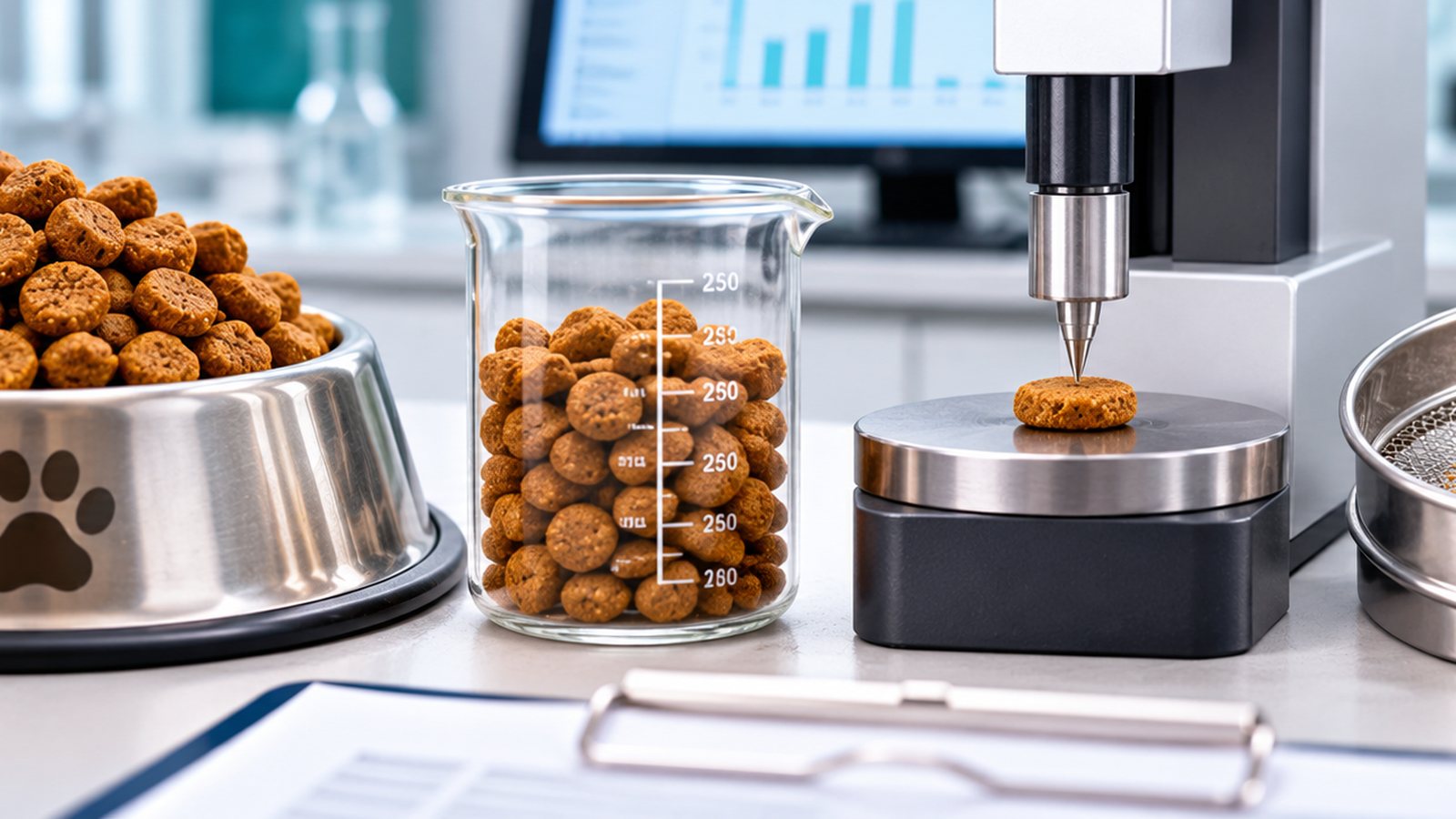
Worked example prepared by Dr Rohan Mehta, Head of Extrusion & Process Development, Guires PNL. Targets are examples, not measured results.
At a glance
- Format
- Extruded dry kibble, round, about 10 mm
- Life stage
- Adult dogs, medium breeds
- Standard
- IS 11968:2019 (India) 5
- Data status
- Hypothetical brief; literature cited for direction only
Example values for the method. IS 11968:2019 defines dry pet food as less than 14% moisture (cl. 3.7), and its Table 1 sets a 10% maximum for dry dog food 5.
What had to hold.
Settings don’t transfer
Specific mechanical energy (SME) is specific to a machine, die and recipe. A setting that works on one line is only a starting range on another, as our extruder guide shows.
Recipe moves the kibble
In seven dog diets, starch source alone changed kibble density, expansion and hardness 2. In a fish feed, 0–4% internal fat lowered SME and radial expansion 3.
Cook sets digestibility
In beagles, the degree of starch gelatinisation changed nutrient digestibility, with an optimum at about 83–87% gelatinisation 1. The kibble has to be cooked enough, not only shaped.
Every target at once
Bulk density, hardness, fines and moisture all have to sit inside their windows on the same run, and the kibble still has to be eaten 6.
Dry dog food development in six stages.
Write the targets first
Species, life stage, kibble format, nutrient standard and the acceptance windows for bulk density, hardness, fines and moisture were written down before any trial.
Run the trial matrix
On a pilot line, with the recipe held constant, we ran three SME levels, two moisture levels and two dies: 3 × 2 × 2 = 12 runs. The matrix brackets the machine’s operating range; the approach is informed by published extrusion studies 13.
Measure every run
Each run is sampled at the die and after drying for bulk density, hardness, expansion ratio, moisture and fines, as described in our kibble quality tests guide. The output is a pass map, not a single winning run 24.
Change one recipe lever at a time
Recipe levers such as starch source or fat level are then changed one at a time, and the pass map is redrawn after each change.
Validate in the bowl
Candidate recipes go into a two-bowl palatability test 6 through our palatability testing, and digestibility is confirmed on the chosen recipe through digestibility studies 1.
Sign off and scale
Choose the lowest-cost setting inside every window, confirm it in a second run, sign the specification, then move to pilot manufacturing and commercial scale-up with the same document.
- 1 · BriefNutrition, format and quality targets
- 2 · Trial matrixSME, moisture, die: 12 runs
- 3 · TestDensity, hardness, fines, moisture
- 4 · ValidatePalatability, digestibility
- 5 · QC specificationTolerances, then scale-up
Process diagram; no data plotted.
What the specification locks.
In a live project, this section reports the measured pass map and the final specification. In this worked example, the outcome is the structure and the decision rules. Tolerances come from the spread seen in repeat runs, plus the customer’s handling needs.
Table 1. Programme at a glance
| Stage | What is done | Output |
|---|---|---|
| Brief and targets | Species, life stage, format, nutrient standard and quality windows agreed | Written target ranges |
| Trial matrix | 3 SME levels × 2 moisture levels × 2 dies, recipe fixed (12 runs) | Run log by setting |
| Measurement | Bulk density, hardness, expansion, moisture and fines at the die and after drying | Pass map |
| Recipe levers | One change at a time, such as starch source or fat level | Updated pass map |
| Validation | Two-bowl palatability and digestibility on the chosen recipe | Accept or revise |
| Specification and scale-up | Sign-off, confirmation run, then pilot | Signed QC specification |
Illustrative programme. Durations and costs vary by project and are not stated.
Table 2. Structure of a kibble QC specification
| Parameter | Example target | Example tolerance | Check frequency |
|---|---|---|---|
| Bulk density | Set from trials | ± agreed window | Every batch |
| Hardness | Set from trials | Minimum and maximum | Per shift |
| Fines in bag | Upper limit set by the developer | Maximum % by sieve | Per batch |
| Moisture | ≤10% (IS 11968:2019 Table 1, dry dog food) 5 | Per standard and shelf life | Every batch |
| Kibble size | Example: about 10 mm | Agreed range | Per shift |
Example values, not measured data. Only the moisture maximum comes from a standard; every other value is set from a project’s own trials.
What this means for brands.
Write targets first
Set quality targets before trials, not after, and keep the formulation notes with the specification.
Keep one record
Machine settings, recipe and tolerances belong in one document, so a second line can reproduce the kibble.
Read the dry pet food guides in order
- Dry pet food market trends in India · where a new brand fits
- Single-screw vs twin-screw extruders · how the machine limits the recipe
- Dry pet food rules in India · IS 11968, FSSAI and import
- Kibble quality tests · bulk density, hardness and fines
- Worked case study · you are here
- Dry pet food product development · how we run it for your product
References
- Loureiro BA, Oliveira MCC, Peixoto MC, Ribeiro EM, Schauf S, Castrillo C, Carciofi AC (2024). Starch gelatinization implications for nutrient digestibility and fermentation products in the faeces of Beagle dogs. Animal Feed Science and Technology 309:115894. Source ↗
- Kaelle GCB, Bastos TS, de Souza RBMS, Fernandes EL, Santos LNA, de Oliveira SG, Félix AP (2024). Starch sources and their influence on extrusion parameters, kibble characteristics and palatability of dog diets. Italian Journal of Animal Science 23(1):388–396. Source ↗
- Scarpim LB, Baller MA, Pacheco LG, Theodoro SS, Carneiro DJ, Carciofi AC (2026). Effects of internal fat content and screw configuration on extrusion traits and kibble characteristics of high-protein, low-starch fish feed. Processes 14(2):310. Source ↗
- Chen Y, Graff T, Cairns AC, Griffin R, Siliveru K, Pezzali JG, Alavi S (2025). Use of insect meals in dry expanded dog food: impact of composition and particulate flow characteristics on extrusion process and kibble properties. Processes 13(7):2083. Source ↗
- Bureau of Indian Standards (2019, reaffirmed 2024). IS 11968:2019 Pet food for dogs and cats: Specification (first revision), cl. 3.7 and Table 1. Source ↗
- Le Guillas G, Vanacker P, Salles C, Labouré H (2024). Insights to study, understand and manage extruded dry pet food palatability. Animals 14(7):1095. Source ↗
Worked example: the targets and tolerances are examples, not measured client data. Final responsibility for product compliance rests with the brand owner placing the product on the market.
Taking a kibble from brief to production?
Send us the species, life stage, kibble format and market. A scientist will reply with a trial plan, the tests we would run and the specification you would receive.
Every Guires PNL product is formulated to comply with the FEDIAF Nutritional Guidelines and the AAFCO Dog and Cat Food Nutrient Profiles. Neither body issues certificates to manufacturers, so compliance is verified independently against their published standards — and every product comes with a complete documentation package for regulatory submissions in the EU, US, Australia and Asian markets.
How we verify compliance →