Dry pet food market trends in India: kibble formats, positioning and what they mean for new brands
India’s kibble category is large, concentrated and still growing. This guide sizes it from one named source, shows how kibble format and positioning interact, and sets out what each trend means for a brand entering the market.
- Dry food was 89.6% of India’s US$539.0 million dog food sales in 2023; wet food was under 1%.
- India’s pet food retail value grew from US$245.4 million in 2018 to US$629.6 million in 2023, and is forecast at US$1,268.8 million in 2028.
- Market-size figures differ several-fold between sources, so quote one source with its year and scope.
- Starch source, kibble shape and size change acceptance and structure, so format is fixed together with the nutrition target.
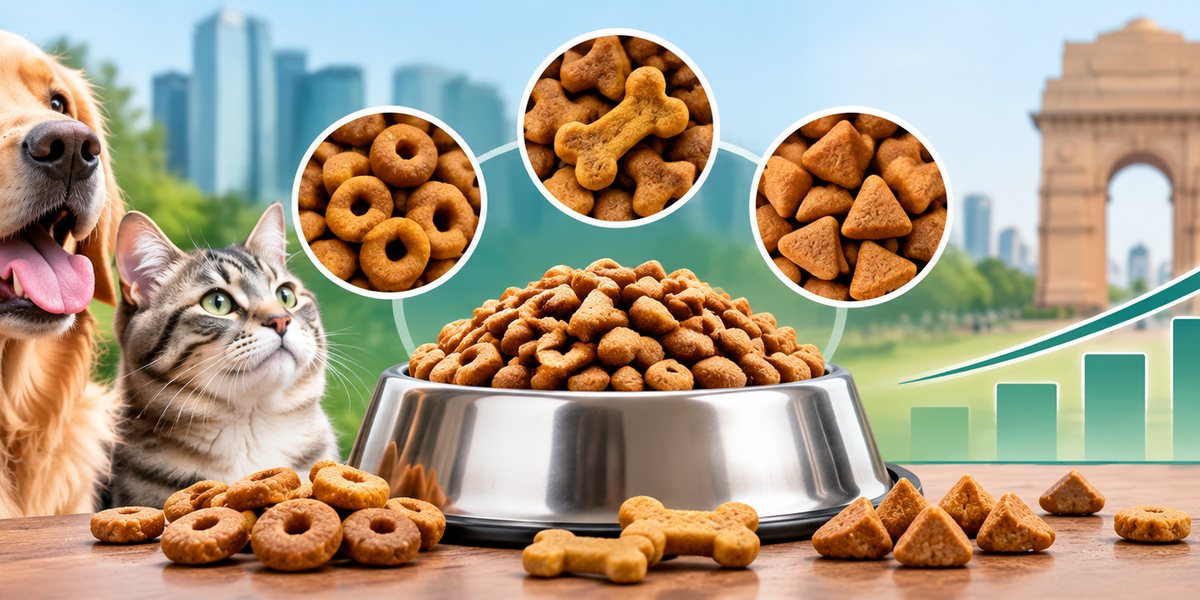
The dry dog food market in India is effectively the dog food market. Dry food made up 89.6% of India’s US$539.0 million dog food sales in 2023, and wet food was under 1% 1. Commercial reports name humanisation, premiumisation, e-commerce and direct-to-consumer (D2C) sales as the main drivers 3. A new brand therefore competes on kibble format, nutrition and claims it can prove, not on price alone.
01The dry pet food market in India
India’s kibble category is large, concentrated and still expanding. For a new brand, the question is less “is there demand?” than “where does my product fit?”. This guide sizes the market, shows how kibble format and positioning interact, and sets out what each trend means for a brand entering the category.
Why kibble leads the category
A Government of Canada market report, using Euromonitor data, puts India’s pet food retail value at US$629.6 million in 2023. Dog food accounted for US$539.0 million (85.6%) of that, and dry food for 89.6% of dog food sales 1. India had 38.5 million pets in 2023, of which 33.6 million were dogs 1. Cat food was US$89.8 million (14.3%), a smaller but separate opportunity. In our reading, kibble leads on ambient storage and cost per feeding; the report itself gives no reason.
| Indicator | Value | Year |
|---|---|---|
| Pet food retail value | US$629.6 million | 2023 |
| Pet food retail value | US$245.4 million | 2018 |
| Growth, 2018–2023 | 20.7% a year (CAGR) | 2018–2023 |
| Dog food sales (share of pet food) | US$539.0 million (85.6%) | 2023 |
| Dry food share of dog food sales | 89.6% (US$482.7 million) | 2023 |
| Wet dog food sales | US$4.8 million (under 1%) | 2023 |
| Pets (of which dogs) | 38.5 million (33.6 million) | 2023 |
| Forecast pet food value | US$1,268.8 million, 15.0% a year | 2028 |
Table 1. India pet food indicators. Source: Agriculture and Agri-Food Canada, Euromonitor International data 1.
Data from Agriculture and Agri-Food Canada (Euromonitor International) 1. Bars are scaled to the 2028 forecast.
View data table
| Year | US$ million |
|---|---|
| 2018 | 245.4 |
| 2023 | 629.6 |
| 2028 (forecast) | 1,268.8 |
Treat any single pet food market size figure with care. IMARC, a commercial research firm, puts India’s dog food market at US$2.9 billion for 2025 3, several times the 2023 retail figure above. Scope and method change the number, so quote one source, with its year and what it covers.
02Growth drivers: humanisation and D2C
Commercial reports list premiumisation, humanisation, e-commerce and direct-to-consumer sales as the main trends in the India dog food market 3. The best consumer evidence comes from the US. In a survey of 206 US pet owners published in 2026, health benefit claims ranked highest, followed by nutrition claims and then price. Owners who strongly “humanise” their pets placed less weight on price 2. The sample was small, recruited online and mostly aged 25 to 34, so read it as an indicator of pet humanisation, not an Indian measurement.
For D2C brands, the practical point is that the claim and the pack reach the buyer with no shelf or retailer to explain them. A claim has to stand on its own.
03Kibble formats by segment
A kibble format is the result of formulation and process. In seven dog diets that each used one starch source, tuber-based diets gave lower bulk density and higher expansion, size and hardness than cereal and pulse diets, while pea gave less expanded kibble with fewer pores 5. Shape matters unevenly. Dogs under 10 kg showed no significant preference between cross-shaped and round kibble, dogs over 10 kg ate more of the cross-shaped kibble, and cats can be sensitive to small changes in shape or texture 6.
| Segment | Format lever | Evidence |
|---|---|---|
| Small breeds (under 10 kg) | No significant shape preference; size the kibble to the mouth | Review of feeding studies 6 |
| Medium and large breeds | Cross-shaped kibble eaten more | Dogs over 10 kg 6 |
| Light, expanded kibble | Tuber starch raises expansion | Lower bulk density 5 |
| Pulse-based recipes | Pea reduces expansion | Fewer pores 5 |
| Dry cat food | Small shape or texture changes can alter acceptance | Review 6 |
Table 2. Format levers by segment. The shape studies used different diets for each size group, so treat the result as indicative. See starch in kibble for how each starch behaves.
04Positioning: premium, grain-free and clean label
Premium positioning rests on proof. In a South Korean study of 96 commercial dog and cat foods, 82.3% of labels matched laboratory analysis for seven mandatory nutrients 4, so a premium claim invites a test. Our audit of Indian dog food labels found similar gaps.
Grain-free shows the risk of positioning on exclusion alone. In its 2019 update, FDA reported that 93% of products named in canine dilated cardiomyopathy (DCM) reports contained peas and/or lentils, and that the issue “may involve multiple factors”. FDA has said adverse-event reports alone do not establish a causal link, and it has issued no update since December 2022 7. Grain-free and clean-label claims should therefore sit on formulation evidence. Nutritional adequacy claims should be made against a recognised standard; see our grain-free and DCM evidence review.
05Dry vs wet: where the market is splitting
Wet dog food was only US$4.8 million in 2023, under 1% of dog food sales, against US$482.7 million for dry 1. In India the split is a premium question, not a volume one. Brands commonly add wet or fresh lines as premium extensions, with dry as the volume line, but we found no India data showing how fast those formats are growing. Buy a current report for the exact split before building a business case on it.
06What the trends mean for new brands
Four decisions to make early
- Start from dry. It is the volume format, so a brand needs a credible kibble first 1.
- Choose the format deliberately. Starch source, shape and size change the product, so fix them together with the nutrition target 56.
- Position only on proof. Test the claim before the pack carries it 47.
- Use one market-size source. State its year and scope 13.
India’s dog food market is kibble-led and growing. It rewards brands that size it from one named source, fix the kibble format together with the formulation, and position only on claims they can prove.
07Questions brands ask
How big is the dry dog food market in India?
Dry food was 89.6% of India’s US$539.0 million dog food sales in 2023, about US$482.7 million, according to a Government of Canada report using Euromonitor data. Commercial reports give larger totals, so state the source, year and scope of any figure you use.
Is dry or wet food more popular for dogs in India?
Dry kibble, by a wide margin. Wet dog food was US$4.8 million in 2023, under 1% of dog food sales. Wet and fresh lines are mainly premium extensions.
What dry dog food trends are shaping the India market?
Commercial reports name premiumisation, humanisation, e-commerce and direct-to-consumer sales as the main trends. Consumer evidence on humanisation comes mostly from US surveys.
What makes a dry dog food brand stand out in India?
Credible nutrition, a kibble format suited to the target dogs, and claims the brand can prove. In a South Korean study of 96 commercial foods, 82.3% of labels matched laboratory analysis, so accurate labels are a real differentiator.
Specialisation: Pet food market intelligence, dry food category analysis, kibble format segmentation, competitive brand positioning, consumer purchasing trends and India’s pet nutrition market.
Read the dry pet food guides in order
- Dry pet food market trends in India · you are here
- Single-screw vs twin-screw extruders · how the machine limits the recipe
- Dry pet food rules in India · IS 11968, FSSAI and import
- Kibble quality tests · bulk density, hardness and fines
- Worked case study · one brief from trials to a QC specification
- Dry pet food product development · how we run it for your product
Sources
- Agriculture and Agri-Food Canada (2024). Sector trend analysis: pet food trends in India. Market intelligence report, Euromonitor International data. Source ↗
- Rombach M, Dean DL (2026). Exploring predictors of US consumers’ pet food preferences: spoiling them one bite at a time! Pets 3(1):8. Source ↗
- IMARC Group (2026). India dog food market: report overview. Page updated 24 September 2026. Source ↗
- Cho H-W, Lee MY, Lee W-D, Lee S-Y, Kim KH, So K-M (2026). Nutritional evaluation of commercial dog and cat foods based on key nutrient requirements. Animals 16(6):909. Source ↗
- Kaelle GCB, Bastos TS, de Souza RBMdS, Fernandes EL, Santos LNA, de Oliveira SG, Félix AP (2024). Starch sources and their influence on extrusion parameters, kibble characteristics and palatability of dog diets. Italian Journal of Animal Science 23(1):388–396. Source ↗
- Le Guillas G, Vanacker P, Salles C, Labouré H (2024). Insights to study, understand and manage extruded dry pet food palatability. Animals 14(7):1095. Source ↗
- U.S. Food and Drug Administration (2022). FDA investigation into potential link between certain diets and canine dilated cardiomyopathy. Page last updated 23 December 2022. Source ↗
Evidence reviewed by the Guires Pet Nutrition Lab scientific team. This article is general information for product developers and is not legal or veterinary advice.
How to cite this article
Choose your referencing style, then copy. Check your university’s, journal’s or regulator’s guide for local variations.
Krishnan, M. (2026, November 5). Dry pet food market trends in India: kibble formats, positioning and what they mean for new brands. Guires Pet Nutrition Lab Insights. https://www.petnutritionlab.com/insights/dry-pet-food-market-trends-india-kibble-formats
Krishnan, Meera. “Dry pet food market trends in India: kibble formats, positioning and what they mean for new brands.” Guires Pet Nutrition Lab Insights, 5 Nov. 2026, www.petnutritionlab.com/insights/dry-pet-food-market-trends-india-kibble-formats. Accessed [date].
Krishnan, M. (2026) Dry pet food market trends in India: kibble formats, positioning and what they mean for new brands. Available at: https://www.petnutritionlab.com/insights/dry-pet-food-market-trends-india-kibble-formats (Accessed: [date accessed]).
Krishnan, Meera. “Dry pet food market trends in India: kibble formats, positioning and what they mean for new brands.” Guires Pet Nutrition Lab Insights. November 5, 2026. https://www.petnutritionlab.com/insights/dry-pet-food-market-trends-india-kibble-formats.
Meera Krishnan, ‘Dry pet food market trends in India: kibble formats, positioning and what they mean for new brands’, Guires Pet Nutrition Lab Insights, 5 November 2026, <https://www.petnutritionlab.com/insights/dry-pet-food-market-trends-india-kibble-formats>, accessed [date accessed].
Krishnan M. Dry pet food market trends in India: kibble formats, positioning and what they mean for new brands [Internet]. Guires Pet Nutrition Lab Insights; 2026 Nov 5 [cited [date]]. Available from: https://www.petnutritionlab.com/insights/dry-pet-food-market-trends-india-kibble-formats
M. Krishnan, “Dry pet food market trends in India: kibble formats, positioning and what they mean for new brands,” Guires Pet Nutrition Lab Insights, Nov. 5, 2026. [Online]. Available: https://www.petnutritionlab.com/insights/dry-pet-food-market-trends-india-kibble-formats
@misc{guirespnl2026drypetfoodmarkettrendsindiakibbleformats,
  author = {Krishnan, Meera},
  title = {{Dry pet food market trends in India: kibble formats, positioning and what they mean for new brands}},
  year = {2026},
  month = oct,
  howpublished = {\url{https://www.petnutritionlab.com/insights/dry-pet-food-market-trends-india-kibble-formats}},
  note = {Guires Pet Nutrition Lab Insights}
}
This article summarises published evidence for product developers. Cite the original sources above for specific findings, and do not reproduce this article as your own work.
Entering India’s dry pet food market?
Tell us your target dogs or cats, price point and positioning. We turn it into a formulation, kibble format and claims plan you can test.