Kibble quality tests: bulk density, hardness, durability and fines
A kibble that passes the nutrient panel can still fail in the bag. This guide covers the core physical tests, how each links back to the recipe and the extruder, and a checklist for QC teams.
- The core kibble quality tests are bulk density, hardness, durability (PDI) and sieve-based fines.
- Each test responds to formulation and process: starch source, protein source, fat and SME all move density and hardness.
- Published hardness values range from about 23 to 112 N depending on diet and method, so they are ranges, not targets.
- IS 11968 sets no physical-quality limits, so each brand writes its own specification from trial data.
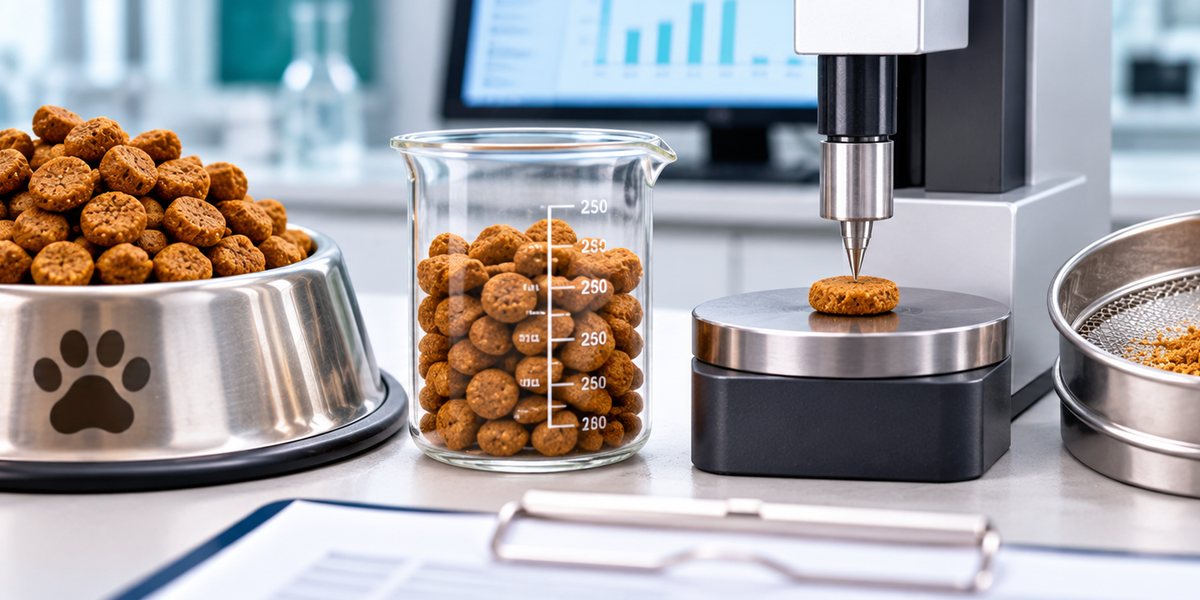
Kibble quality is the physical performance of dry pet food. It covers how densely the kibble packs, how hard it is, and how well it survives handling without breaking into fines. The core tests are bulk density, hardness, durability (PDI) and sieve-based fines, and each responds to formulation and extrusion settings 123. Published values differ widely between studies and methods, so set limits on your own method and product.
01What makes good kibble
A kibble that passes the nutrient panel can still fail in the bag. It may be crushed in transit, leave dust in the bowl, or be too hard for small dogs. Physical tests catch these problems before they reach the customer. This guide covers the main tests and how each one links back to the recipe and the machine.
Good kibble means pieces of consistent size, density and texture that survive filling, transport and storage. These properties decide how much fits in a bag, how the pet chews, and how much dust reaches the owner. They also reach the bowl: a review of palatability research notes that fibre, fat, and kibble size and shape affect acceptance, and that density may play a role too 5.
What the Indian standard does not set
IS 11968:2019 (reaffirmed 2024) sets nutrient, contaminant, hygiene, packing and labelling requirements. Its Clause 5.1 gives a general description: meal, crumbs or biscuits, free from rancidity, mould and insects. It sets no limits for bulk density, hardness, durability or fines 6, so each brand has to write its own. Our guide to the rules in India covers what the standard does require.
02Bulk density
The bulk density test weighs a known volume of kibble, for example a 1 L cup filled to the brim in triplicate, and reports g/L 2. Density decides pack weight and fill, so treat it as the first gate in pet food quality control.
- Starch source. In seven dog diets, tuber-based kibble had lower density and greater expansion than cereal- and pulse-based kibble 3.
- Protein source. Wet bulk density was 328–382 g/L for insect-meal kibble against 304–306 g/L for poultry-meal and fish-meal kibble, but after drying the differences were not significant (287–306 g/L). Sectional expansion was 3.02 for poultry meal and only 1.22 for black soldier fly larvae (BSFL) 2.
- Fat. In a fish feed, raising preconditioner fat from 0 to 4% increased post-drying bulk density by about 85 g/L, to a high of 412.8 g/L 4. Read the direction for pet food, not the numbers.
03Hardness and durability
Kibble hardness is the peak force needed to break a piece. It is measured with a texture analyser or a tablet-type hardness tester and reported in newtons or kilograms-force. The method matters: one study compressed two kibbles at a time with a 25 mm probe 2, while another used a durometer 3.
- Replacing grain with surplus bread crumb gave extrudates with hardness from 49.4 N down to 23.1 N as the bread content rose. In vitro dry matter digestibility did not change, though crude protein digestibility fell 1.
- As BSFL rose from 0 to 30% of the diet, hardness fell from 11.45 to 6.55 kg 2.
Bread diets 1; BSFL diets converted by Guires PNL from 6.55–11.45 kgf (× 9.807), two kibbles per compression 2. Axis 0–120 N. These are ranges, not targets.
View data table
| Diet set | Hardness (N) |
|---|---|
| Surplus bread diets | 23.1–49.4 |
| 0–30% BSFL diets | 64.2–112.3 |
Durability (PDI) measures how much of a sample stays intact after tumbling or air agitation. In the ASAE S269 tumbling-can method, 500 g of sieved product is tumbled at 50 rpm for 10 minutes and then re-sieved. The Holmen tester instead blows 100 g with forced air for 30 to 120 seconds. In both, PDI is the percentage retained 7. The methods were developed for feed pellets, and we found no recent peer-reviewed PDI dataset for kibble, so validate the method and limits on your own product.
04Fines and breakage
Fines in pet food are broken pieces and dust, measured by sieve analysis of a bagged sample. In our experience they come from soft or brittle kibble, rough handling and heavy coating loads, and they rise when the product is over-dried. Track moisture and water activity alongside the physical tests, because a kibble that is hard but over-dry can shatter. Set an upper fines limit for each batch and bagging point, and check breakage again after shipping.
| Test | Measures | What moves it | Evidence |
|---|---|---|---|
| Bulk density | Weight per litre (g/L) | Starch source, protein source, fat, expansion | 234 |
| Hardness | Peak break force (N or kgf) | Ingredient mix, SME, fibre, fat | 123 |
| Expansion ratio | Kibble size against die size | Starch type, SME, moisture | 23 |
| Durability (PDI) and fines | Intact fraction, dust | Hardness, moisture, handling | Method 7; no recent kibble dataset |
Table 1. Core kibble tests and what moves them.
05From a failed test to a lever
Every test points back to a lever. In our reading of the studies, a softer, denser kibble suggests lower SME, more fat in the dough or a starch that expands poorly 34. The extruder guide explains the machine side, starch in kibble covers ingredient choice, and how kibble is made covers the process.
Three common misreadings
- Copying another brand’s numbers. Units, probes and speeds differ, so the values in Figure 1 are ranges, not targets 12.
- Reading hardness as durability. A hard piece can still shatter or make fines if it is over-dry, so test the two separately.
- Treating a fish-feed or insect-meal result as a dog-food rule. Each applies to its own diet and machine 24.
06A kibble testing checklist
Write the method down before setting any limit
- Define the method, sample size and units for each test, including the instrument, probe, speed and pieces per test.
- Measure bulk density at the line and in the bag for every batch.
- Test hardness on a fixed number of pieces and report the mean and spread.
- Run sieve analysis for fines on filled bags, not only on line samples.
- Track moisture and water activity alongside the physical tests.
- Link each failed result to a lever: SME, moisture, die, recipe or handling.
- Review limits after any change of ingredient, supplier or screw profile.
Kibble quality is the part of a diet a plant can measure every hour. Bulk density, hardness, durability and fines all trace back to the recipe and the extruder, so write the specification from your own trials.
07Questions QC teams ask
What is kibble quality?
It is the physical performance of dry food: consistent size and shape, bulk density, hardness, durability and low fines. Formulation and extrusion control it, and simple QC tests check it.
How is kibble hardness measured?
Hardness is the peak force needed to break a piece, measured with a texture analyser or tablet-type hardness tester. Results are reported in newtons or kilograms-force, so always record the probe, speed and number of pieces.
What is the bulk density test for kibble?
Bulk density is the weight of kibble in a fixed volume, usually reported in g/L. It reflects expansion and decides pack weight and feeding volume.
What causes fines in dry pet food?
In our experience, fines come from soft or brittle kibble, over-drying, heavy coating loads and rough handling. A sieve test of bagged samples shows how much dust and breakage reaches the customer.
Specialisation: Extrusion trial design, kibble structure, formulation–process interaction and scale-up.
Read the dry pet food guides in order
- Dry pet food market trends in India · where a new brand fits
- Single-screw vs twin-screw extruders · how the machine limits the recipe
- Dry pet food rules in India · IS 11968, FSSAI and import
- Kibble quality tests · you are here
- Worked case study · one brief from trials to a QC specification
- Dry pet food product development · how we run it for your product
Sources
- Mevliyaoğulları E, Karslı MA, Mert B (2023). Utilizing surplus bread as an ingredient in dog food: evaluating baking and extrusion processing on physicochemical properties and in vitro digestibility performance. Journal of Cereal Science 113:103741. Source ↗
- Chen Y, Graff T, Cairns AC, Griffin R, Siliveru K, Pezzali JG, Alavi S (2025). Use of insect meals in dry expanded dog food: impact of composition and particulate flow characteristics on extrusion process and kibble properties. Processes 13(7):2083. Source ↗
- Kaelle GCB, Bastos TS, de Souza RBMdS, Fernandes EL, Santos LNA, de Oliveira SG, Félix AP (2024). Starch sources and their influence on extrusion parameters, kibble characteristics and palatability of dog diets. Italian Journal of Animal Science 23(1):388–396. Source ↗
- Scarpim LB, Baller MA, Pacheco LG, Theodoro SS, Carneiro DJ, Carciofi AC (2026). Effects of internal fat content and screw configuration on extrusion traits and kibble characteristics of high-protein, low-starch fish feed. Processes 14(2):310. Source ↗
- Le Guillas G, Vanacker P, Salles C, Labouré H (2024). Insights to study, understand and manage extruded dry pet food palatability. Animals 14(7):1095. Source ↗
- Bureau of Indian Standards (2019, reaffirmed 2024). IS 11968:2019 Pet food for dogs and cats — Specification (first revision). Source ↗
- Stark C, Fahrenholz A (2015). Evaluating pellet quality. Kansas State University Research and Extension, MF3228. Source ↗
Evidence reviewed by the Guires Pet Nutrition Lab scientific team. This article is general information for product developers and is not legal or veterinary advice.
How to cite this article
Choose your referencing style, then copy. Check your university’s, journal’s or regulator’s guide for local variations.
Mehta, R. (2026, November 5). Kibble quality tests: bulk density, hardness, durability and fines. Guires Pet Nutrition Lab Insights. https://www.petnutritionlab.com/insights/kibble-quality-tests-bulk-density-hardness-fines
Mehta, Rohan. “Kibble quality tests: bulk density, hardness, durability and fines.” Guires Pet Nutrition Lab Insights, 5 Nov. 2026, www.petnutritionlab.com/insights/kibble-quality-tests-bulk-density-hardness-fines. Accessed [date].
Mehta, R. (2026) Kibble quality tests: bulk density, hardness, durability and fines. Available at: https://www.petnutritionlab.com/insights/kibble-quality-tests-bulk-density-hardness-fines (Accessed: [date accessed]).
Mehta, Rohan. “Kibble quality tests: bulk density, hardness, durability and fines.” Guires Pet Nutrition Lab Insights. November 5, 2026. https://www.petnutritionlab.com/insights/kibble-quality-tests-bulk-density-hardness-fines.
Rohan Mehta, ‘Kibble quality tests: bulk density, hardness, durability and fines’, Guires Pet Nutrition Lab Insights, 5 November 2026, <https://www.petnutritionlab.com/insights/kibble-quality-tests-bulk-density-hardness-fines>, accessed [date accessed].
Mehta R. Kibble quality tests: bulk density, hardness, durability and fines [Internet]. Guires Pet Nutrition Lab Insights; 2026 Nov 5 [cited [date]]. Available from: https://www.petnutritionlab.com/insights/kibble-quality-tests-bulk-density-hardness-fines
R. Mehta, “Kibble quality tests: bulk density, hardness, durability and fines,” Guires Pet Nutrition Lab Insights, Nov. 5, 2026. [Online]. Available: https://www.petnutritionlab.com/insights/kibble-quality-tests-bulk-density-hardness-fines
@misc{guirespnl2026kibblequalitytestsbulkdensityhardnessfines,
  author = {Mehta, Rohan},
  title = {{Kibble quality tests: bulk density, hardness, durability and fines}},
  year = {2026},
  month = oct,
  howpublished = {\url{https://www.petnutritionlab.com/insights/kibble-quality-tests-bulk-density-hardness-fines}},
  note = {Guires Pet Nutrition Lab Insights}
}
This article summarises published evidence for product developers. Cite the original sources above for specific findings, and do not reproduce this article as your own work.
Need a kibble specification?
Send us samples or trial data. We run bulk density, hardness, durability and fines testing and set limits from your own product.