Upcycled ingredients in pet food: nutrition, safety and claims
Side streams from human food manufacturing can earn a place in pet food. This guide covers what counts as upcycled, what the nutrition and safety evidence shows, and how to make a claim that survives an audit.
- An input is upcycled when it was made for human food and would otherwise have gone to a waste destination, including animal feed, and the diversion is documented.
- Nutrition is stream-specific: a lentil pasta by-product replaced up to two-thirds of the rice in dog diets without lowering digestibility; spent grain needs processing.
- By-products frequently carry mycotoxins, so screen every lot.
- “Upcycled” is a sourcing claim backed by records and, for the mark, a valid certificate.
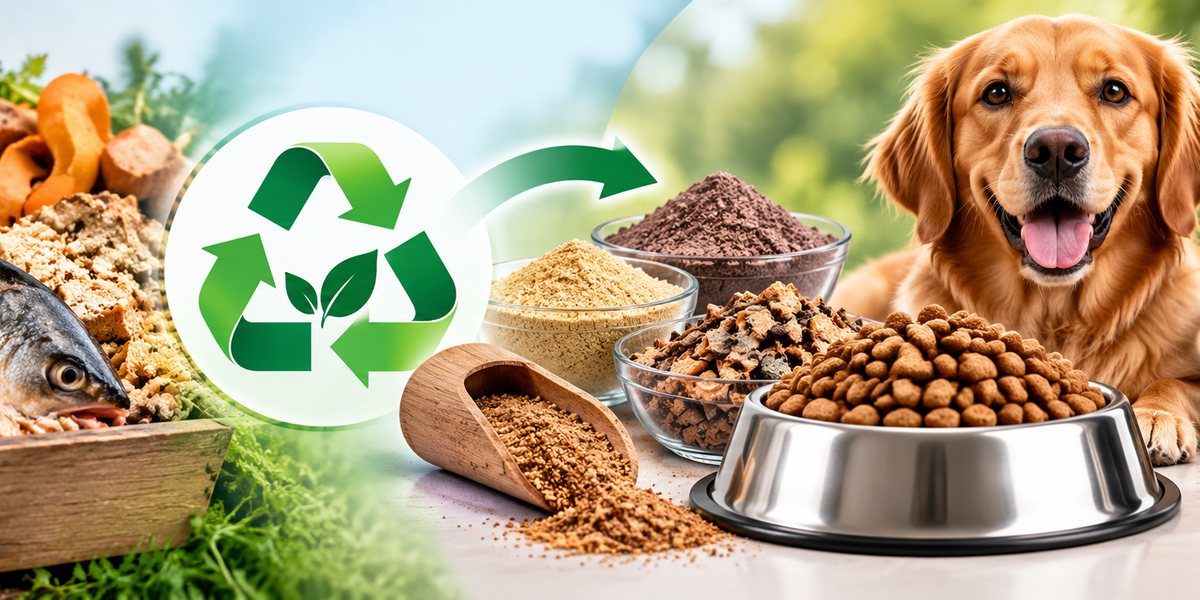
Upcycled ingredients in pet food are materials originally produced for human food that would otherwise have gone to waste, such as brewers’ spent grain, with that diversion documented 7. Their nutrition is stream-specific. Spent grain is perishable and poorly digested by non-ruminants unless processed 2. A lentil pasta by-product replaced up to two-thirds of the rice in extruded dog diets without lowering digestibility 4. Safety rests on supplier checks and mycotoxin screening 3. An “upcycled” claim rests on records that prove the diversion.
01What upcycled ingredients are
Pet food teams are asked to use side streams from human food manufacturing, from spent grain to surplus bread, and buyers expect a sustainability story. The material still has to meet a nutrient target, pass a safety review and carry a claim that can be audited. This guide is written for US-led markets.
Under the Upcycled Certified standard, an input counts as upcycled when it was originally produced for human food and would otherwise have gone to a food loss or waste destination. Those destinations include landfill, sewer, composting and anaerobic digestion, and also animal feed, so diverting a stream from feed to pet food still qualifies. The supply chain must be auditable 7. Companion pet food is an eligible category 7. A 2025 review notes that many countries treat upcycling as part of food waste management rather than a distinct food category, and that no single legal definition exists 1.
Upcycled vs by-product vs waste
A by-product is any secondary output of processing. It is upcycled only when its diversion from a waste destination is documented. The same material can be upcycled in one supply chain and an ordinary by-product in another, so upcycled pet food is defined by evidence of diversion, not by the ingredient name.
02Nutrition: value and variability
The best-described streams are brewers’ spent grain, a lentil pasta by-product and surplus bread. None can be assumed to behave like another.
- Brewers’ spent grain carries about 15–30% protein on a dry matter basis, but it is highly perishable, its protein is poorly soluble, and it is poorly digested by non-ruminants unless processed, for example into hydrolysates 2.
- Lentil pasta by-product. In 40 beagles fed extruded diets, replacing 33% or 66% of the rice with the by-product did not reduce total tract digestibility. Full replacement lowered dry matter and energy digestibility, and faecal output, short-chain fatty acids and faecal biogenic amines rose with inclusion 4.
- Surplus bread. In baked and extruded dog food tested in vitro, dry matter digestibility did not change, while crude protein digestibility fell as the bread content rose 5. There is no feeding trial yet.
| Stream | Evidence | Finding | Limit |
|---|---|---|---|
| Brewers’ spent grain | Review 2 | Protein-rich; low digestibility unless processed | Pet food use of processed fractions largely unexplored |
| Lentil pasta by-product | Feeding trial, 40 dogs 4 | No loss of digestibility at 33% and 66% rice replacement | Lower digestibility at 100%; faecal amines rose |
| Surplus bread | In vitro, baked and extruded 5 | Dry matter digestibility unchanged; crude protein digestibility fell | No feeding trial |
Table 1. Evidence for upcycled streams in dog diets. Findings apply to the tested diets and inclusion levels only.
Managing batch-to-batch variability
Upcycled supply is inconsistent in both quantity and quality 1. The mitigations reviewed include partnerships with the companies that produce or collect the waste, and optical, NIR or neural-network sorting, which is still at pilot scale 1. Set limits for each lot, then confirm the finished diet against its targets.
03Safety and traceability
A 2023 systematic review of six food industry by-products, from distillers’ grains and spent grain to grape pomace and sugar beet pulp, frequently found aflatoxin B1, ochratoxin A, fumonisins, deoxynivalenol and zearalenone. Several were above human food limits, and co-contamination was common, although average levels were often within feed guidance 3. Food safety law applies to these inputs, but there are no specific limits for by-products 1. Screen every lot for mycotoxins.
Traceability is also what certification examines. It looks for inputs traced from receipt to finished item, a chain of custody and records kept for at least three years. It also asks for a supplier attestation plus proof of regulatory compliance or a HACCP, GMP, GAP or GFSI-benchmarked certificate 7.
04Claims and certification
Treat “upcycled” as a statement about sourcing. It says nothing about nutrition or safety, and it does not replace the ingredient’s name. FDA’s Animal Food Ingredient Consultation process reviews an ingredient’s name, definition, manufacture, intended use and safety; it does not assess sourcing claims 6.
| Upcycled Certified designation | Minimum upcycled input |
|---|---|
| Certified Ingredient | At least 95% by weight |
| Certified Product | At least 10% by weight, or an annual tonnage minimum set by sales tier |
| Minimal Content Product | Below the Certified Product threshold |
Table 2. Designations under the Upcycled Certified standard, version 3.0 (June 2025). Applicants must also report food waste created in their own manufacturing; items with a net negative food waste impact cannot be certified 7.
Do
- State the stream and what it replaces, for example spent grain in place of part of a cereal.
- Keep the proof of diversion: supplier attestations, invoices, bills of lading and receiving logs 7.
- Use the ingredient’s recognised name; FDA’s guidance points to the definitions in AAFCO’s Official Publication 6.
- Use the mark only with a valid certificate and licensing agreement 7.
Avoid
- Implying better nutrition or safety than testing shows 23.
- Calling a product upcycled below the certification threshold 7.
- Unqualified “sustainable” or “eco-friendly” claims; in the US the FTC Green Guides expect specific, substantiated environmental claims 8.
- Treating “upcycled” as a regulatory ingredient category; the standard is a private scheme 1.
05Formulating with upcycled ingredients
Choose upcycled ingredients the way you choose any ingredient: on nutrient fit, safety and consistency first, and the sourcing story second. The gain must show in the finished diet, not only in the footprint.
- 1 · Define the streamOrigin, prior waste destination, weight ratio
- 2 · Specify and testNutrient ranges per lot; finished-diet digestibility
- 3 · Screen contaminantsMycotoxins on every lot; supplier HACCP or GMP
- 4 · Plan variabilityDual supply or blending; re-check on any change
- 5 · Review the claimWording matched to records and market rules
Compiled from the Upcycled Certified standard and the cited reviews 137.
Some upcycled streams perform well, others need processing, and every one needs a contaminant screen and a paper trail. Choose the stream for its nutrition, prove its origin, and match the claim to your records.
06For brands and formulators
07Questions brands ask
What are upcycled ingredients in pet food?
Materials originally produced for human food that would otherwise have gone to a food loss or waste destination, used instead in pet food with the diversion documented. A by-product only counts as upcycled when that evidence exists.
Are upcycled pet food ingredients safe?
They can be, with verified suppliers, contaminant testing and traceability, as for any ingredient. Mycotoxins are common in food industry by-products, so every lot should be screened.
Do upcycled ingredients provide good nutrition for pets?
Some do. A lentil pasta by-product replaced up to two-thirds of the rice in extruded dog diets without lowering digestibility, while brewers’ spent grain is poorly digested unless processed. Specify and test each stream.
What can brands claim about upcycled ingredients?
A specific, substantiated sourcing claim, and the Upcycled Certified mark only with a valid certificate and above the threshold. Avoid implying better nutrition or safety, and avoid unqualified environmental claims.
Specialisation: By-product valorisation, ingredient validation, digestibility and palatability testing, and label and claims review.
Sources
- Swaraj AN, Moses JA, Manickam L (2025). Sustainable food upcycling: perspectives on manufacturing challenges and certification requirements for large-scale commercialization. Sustainable Food Technology 3(3):648–664. Source ↗
- Osei ED, Naik AS, Kinsella G, Delaney T, Kirwan S (2025). Potential of brewer’s spent grain bioactive fractions as functional ingredients for companion and farm animal foods: a review. Applied Food Research 5(2):101138. Source ↗
- Lopes P, Sobral MMC, Lopes GR, Martins ZE, Passos CP, Petronilho S, Ferreira IMPLVO (2023). Mycotoxins’ prevalence in food industry by-products: a systematic review. Toxins 15(4):249. Source ↗
- Penazzi L, Freire TGB, Theodoro SdS, Frias JL, Ala U, Carciofi AC, Prola L (2024). Lentils pasta by-product in a complete extruded diet for dogs and its effect on extrusion, digestibility, and carbohydrate metabolism. Frontiers in Veterinary Science 11:1429218. Source ↗
- Mevliyaoğulları E, Karslı MA, Mert B (2023). Utilizing surplus bread as an ingredient in dog food: evaluating baking and extrusion processing on physicochemical properties and in vitro digestibility performance. Journal of Cereal Science 113:103741. Source ↗
- U.S. Food and Drug Administration (2025, July). Guidance for industry #294: Animal food ingredient consultation (AFIC). First issued January 2025. Source ↗
- Where Food Comes From, Inc. (2025, June). Upcycled Certified standard, version 3.0. Originally published by the Upcycled Food Association (2020). Source ↗
- U.S. Federal Trade Commission. Guides for the use of environmental marketing claims (Green Guides), 16 CFR Part 260. Source ↗
Evidence reviewed by the Guires Pet Nutrition Lab scientific team. This article is general information for product developers and is not legal or veterinary advice.
How to cite this article
Choose your referencing style, then copy. Check your university’s, journal’s or regulator’s guide for local variations.
Iyer, M. (2026, November 5). Upcycled ingredients in pet food: nutrition, safety and claims. Guires Pet Nutrition Lab Insights. https://www.petnutritionlab.com/insights/upcycled-ingredients-pet-food-nutrition-safety-claims
Iyer, Meera. “Upcycled ingredients in pet food: nutrition, safety and claims.” Guires Pet Nutrition Lab Insights, 5 Nov. 2026, www.petnutritionlab.com/insights/upcycled-ingredients-pet-food-nutrition-safety-claims. Accessed [date].
Iyer, M. (2026) Upcycled ingredients in pet food: nutrition, safety and claims. Available at: https://www.petnutritionlab.com/insights/upcycled-ingredients-pet-food-nutrition-safety-claims (Accessed: [date accessed]).
Iyer, Meera. “Upcycled ingredients in pet food: nutrition, safety and claims.” Guires Pet Nutrition Lab Insights. November 5, 2026. https://www.petnutritionlab.com/insights/upcycled-ingredients-pet-food-nutrition-safety-claims.
Meera Iyer, ‘Upcycled ingredients in pet food: nutrition, safety and claims’, Guires Pet Nutrition Lab Insights, 5 November 2026, <https://www.petnutritionlab.com/insights/upcycled-ingredients-pet-food-nutrition-safety-claims>, accessed [date accessed].
Iyer M. Upcycled ingredients in pet food: nutrition, safety and claims [Internet]. Guires Pet Nutrition Lab Insights; 2026 Nov 5 [cited [date]]. Available from: https://www.petnutritionlab.com/insights/upcycled-ingredients-pet-food-nutrition-safety-claims
M. Iyer, “Upcycled ingredients in pet food: nutrition, safety and claims,” Guires Pet Nutrition Lab Insights, Nov. 5, 2026. [Online]. Available: https://www.petnutritionlab.com/insights/upcycled-ingredients-pet-food-nutrition-safety-claims
@misc{guirespnl2026upcycledingredientspetfoodnutritionsafetyclaims,
  author = {Iyer, Meera},
  title = {{Upcycled ingredients in pet food: nutrition, safety and claims}},
  year = {2026},
  month = oct,
  howpublished = {\url{https://www.petnutritionlab.com/insights/upcycled-ingredients-pet-food-nutrition-safety-claims}},
  note = {Guires Pet Nutrition Lab Insights}
}
This article summarises published evidence for product developers. Cite the original sources above for specific findings, and do not reproduce this article as your own work.
Validating an upcycled ingredient?
Tell us the stream, supplier and target product. We test lots, check the finished diet and review the claim wording before print.