Starch gelatinization and digestibility in extruded diets: one study explained
Grind size is one of the cheapest levers in kibble production. One controlled trial in 54 dogs shows how cereal particle size changes starch gelatinization and digestibility, and where its lessons stop.
- In 54 dogs fed nine extruded diets, finer cereal grinds gave more starch gelatinization.
- Coarser maize and sorghum lowered total tract digestibility; rice was largely unaffected within the range tested.
- Grind targets often quoted from this study were suggested by its senior author in a news release, not tested in the paper.
- Measure gelatinization on finished kibble rather than assume it from extruder settings.
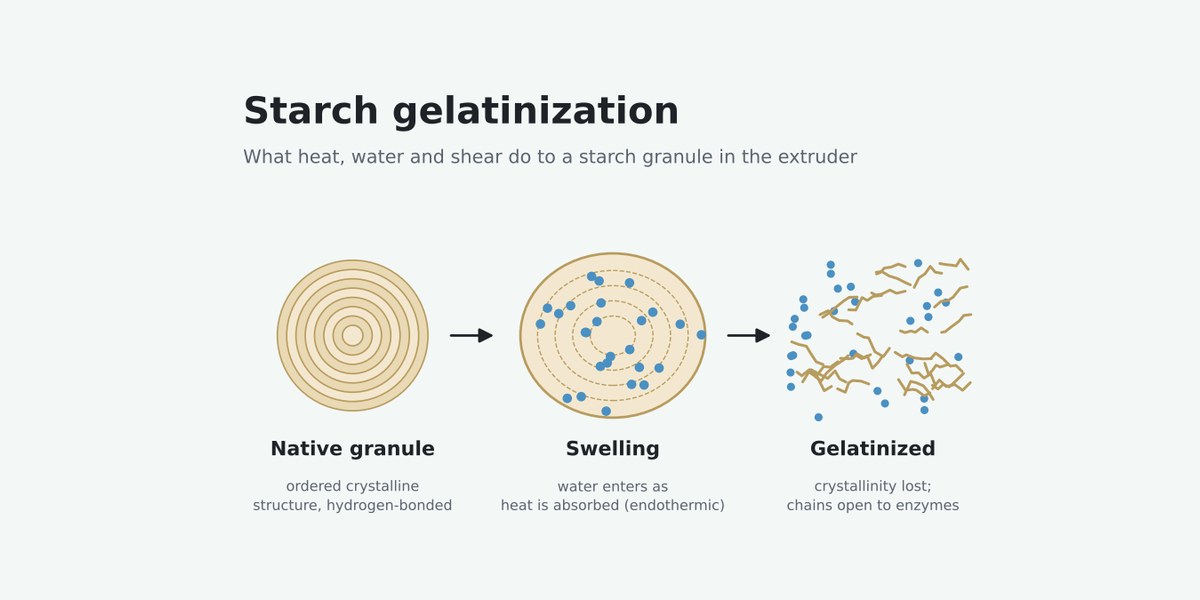
Starch gelatinization is the loss of a starch granule’s ordered structure when it is heated with water, which opens the starch to digestive enzymes. In a controlled trial of 54 dogs fed nine extruded diets, a finer cereal grind gave more gelatinization. Coarser maize and sorghum lowered total tract digestibility, while rice was largely unaffected 1. The practical lesson for kibble is to set grind size by cereal and to measure gelatinization rather than assume it.
01What starch gelatinization is
Grind size is one of the cheapest levers in kibble production, and one of the most overlooked. This guide explains one study that tested it, what the study found, and how far its results can be turned into process settings.
In a native starch granule, amylose and amylopectin chains are packed into a partly crystalline structure held by hydrogen bonds. Heated in water, the granule absorbs water and swells, the ordered structure is lost, and the chains become open to enzymes. The change absorbs heat, so it is an endothermic reaction, and it is the same change that lets starch work as a thickener and gelling agent in human food. In an extruder, heat, moisture and shear drive it. Raw starch is poorly digested by dogs and cats, and gelatinization improves the digestibility of maize, barley and tapioca starch 2.
02The study at a glance
| Citation | Bazolli RS, Vasconcellos RS, de-Oliveira LD, Sá FC, Pereira GT, Carciofi AC. J Anim Sci 2015;93(6):2956–2966 1 |
|---|---|
| Question | Does cereal particle size change starch gelatinization and digestibility in extruded dog food? |
| Design | 3 × 3 factorial: rice, maize or sorghum, each ground to three sizes; nine extruded diets |
| Particle sizes | About 300, 450 and 600 µm mean geometric diameter (MGD) |
| Animals | 54 adult beagles, 12.0 ± 0.1 kg; six dogs per diet, randomly assigned |
| Measures | Starch gelatinization, total tract apparent digestibility (chromium oxide marker), faecal short-chain fatty acids (SCFA) and lactate |
| Funding | Mogiana Alimentos (Guabi), a Brazilian pet food maker, per the university repository record |
Table 1. Study design, from the published abstract 1. The adaptation and collection periods are in the full text, which we could not access.
03What the researchers did
The team built three diets, each around one cereal: rice, maize or sorghum. Each cereal was ground to three sizes with the same grinding procedure, and all nine diets were extruded into kibble with similar nutrient profiles. Dogs ate their assigned diet, digestibility was calculated with chromium oxide as an indigestible marker, and results were tested by ANOVA with Tukey tests and polynomial contrasts 1.
04What they found
- Finer grind, more gelatinization. Particle size was inversely related to starch gelatinization across the nine diets (r² = 0.85, P < 0.001). With the same mill, rice broke down to smaller particles than maize or sorghum 1.
- Maize and sorghum lost digestibility as particles grew. Total tract apparent nutrient digestibility fell with larger MGD and lower gelatinization (P < 0.01), and for sorghum the fall was linear 1.
- Rice was less sensitive. Rice nutrient digestibility did not change with grind (P > 0.05); only gross energy digestibility fell, at the largest size (P < 0.01) 1.
- Fermentation shifted. Sorghum diets gave higher faecal total SCFA, and rice diets lower faecal lactate (both P < 0.05). In maize and sorghum diets, propionate and butyrate rose as particle size increased (P < 0.05), but not in rice 1. In our reading, this is consistent with more starch reaching the colon.
Calculated by Guires PNL from the published regression SG = 106.32 − 0.0699 × MGD (r² = 0.85, n = 9 diets) 1. Values are predictions across all three cereals, not measured results for one diet. Axis 0–100%.
View data table
| Mean particle size | Predicted gelatinization (%) |
|---|---|
| 300 µm | 85.4 |
| 450 µm | 74.9 |
| 600 µm | 64.4 |
05Limits, and what the study does not show
- Six dogs per diet is a standard digestibility panel, but it has limited power to detect small differences.
- One breed, one body size and healthy adults only.
- Grind was the study variable; extrusion conditions were not.
- The work was industry-funded. The design is sound, but readers should know it.
The study does not show that coarse grinding harms dogs, or that one cereal is “better”. It does not test pregelatinized starch ingredients, glucose response or long-term health. Other work found starch digestibility above 98% for six carbohydrate sources, yet their post-meal glucose and insulin responses differed 4, so digestibility and glycaemic effect should be judged separately.
06What it means for product development
In a news release on the study, senior author Aulus Carciofi suggested a mean particle size below 350 µm for rice and below 300 µm for maize and sorghum. For maize- and sorghum-based diets he advised no particles above 600 µm and no more than 10–15% above 400 µm, because large particles do not have time to hydrate and cook fully in the extruder 3. These are expert suggestions, not tested limits.
| Setting | What the evidence supports | Practical check |
|---|---|---|
| Grind (MGD) | Rice below 350 µm; maize and sorghum below 300 µm, as suggested by the senior author 3 | Particle size distribution for each cereal lot |
| Coarse tail | Maize and sorghum: none above 600 µm, at most 10–15% above 400 µm 3 | Sieve analysis at every hammer-mill screen change |
| Preconditioning | Larger particles need longer to hydrate and cook 3 | Review retention time when moving to maize or sorghum |
| Gelatinization | Tracks particle size and, for maize and sorghum, digestibility 1 | Measure on finished kibble as a release test |
| Cereal switch | Rice digestibility was less sensitive to grind within the range tested 1 | Re-validate digestibility when replacing rice |
Table 2. From study to process settings.
For how starch sources compare, see starch in kibble; for the whole process, read how kibble is made, and for measuring the result, kibble quality tests.
A good single study with a clear message: grind finer for maize and sorghum, and measure gelatinization on the kibble. The suggested grind targets come from the senior author, not the paper’s data, so validate them on your own process.
07For brands and formulators
08Questions formulators ask
What is starch gelatinization?
It is the loss of a starch granule’s ordered, partly crystalline structure when it is heated with water. The granule swells and the starch becomes open to digestive enzymes. In an extruder, heat, moisture and shear drive it.
Does grind size affect kibble digestibility?
In one 54-dog study it did for maize and sorghum: coarser grinds gave less gelatinization and lower total tract digestibility. Rice digestibility was largely unaffected within the range tested.
What particle size should cereals be ground to for extruded dog food?
The study’s senior author suggested a mean below 350 µm for rice and below 300 µm for maize and sorghum, with no maize or sorghum particles above 600 µm. These are expert suggestions, so confirm them on your own line.
Is more digestible starch always better for dogs?
Not necessarily. Starch sources with similar digestibility can still differ in post-meal glucose and insulin response, so digestibility and glycaemic effect should be judged separately.
Sources
- Bazolli RS, Vasconcellos RS, de-Oliveira LD, Sá FC, Pereira GT, Carciofi AC (2015). Effect of the particle size of maize, rice, and sorghum in extruded diets for dogs on starch gelatinization, digestibility, and the fecal concentration of fermentation products. Journal of Animal Science 93(6):2956–2966. Source ↗
- Ward L (2024). Formulation requirements on moisture and starch for extrusion. Global Pet Industry, 28 March 2024. Source ↗
- American Society of Animal Science (2015). Dog food processing methods answering questions. News release, 6 August 2015, via EurekAlert! Source ↗
- Carciofi AC, Takakura FS, de-Oliveira LD, Teshima E, Jeremias JT, Brunetto MA, Prada F (2008). Effects of six carbohydrate sources on dog diet digestibility and post-prandial glucose and insulin response. Journal of Animal Physiology and Animal Nutrition 92(3):326–336. Source ↗
Evidence reviewed by the Guires Pet Nutrition Lab scientific team. This article is general information for product developers and is not legal or veterinary advice.
How to cite this article
Choose your referencing style, then copy. Check your university’s, journal’s or regulator’s guide for local variations.
Mehta, P. (2026, November 10). Starch gelatinization and digestibility in extruded diets: one study explained. Guires Pet Nutrition Lab Insights. https://www.petnutritionlab.com/insights/starch-gelatinization-digestibility-extruded-diets
Mehta, Priya. “Starch gelatinization and digestibility in extruded diets: one study explained.” Guires Pet Nutrition Lab Insights, 10 Nov. 2026, www.petnutritionlab.com/insights/starch-gelatinization-digestibility-extruded-diets. Accessed [date].
Mehta, P. (2026) Starch gelatinization and digestibility in extruded diets: one study explained. Available at: https://www.petnutritionlab.com/insights/starch-gelatinization-digestibility-extruded-diets (Accessed: [date accessed]).
Mehta, Priya. “Starch gelatinization and digestibility in extruded diets: one study explained.” Guires Pet Nutrition Lab Insights. November 10, 2026. https://www.petnutritionlab.com/insights/starch-gelatinization-digestibility-extruded-diets.
Priya Mehta, ‘Starch gelatinization and digestibility in extruded diets: one study explained’, Guires Pet Nutrition Lab Insights, 10 November 2026, <https://www.petnutritionlab.com/insights/starch-gelatinization-digestibility-extruded-diets>, accessed [date accessed].
Mehta P. Starch gelatinization and digestibility in extruded diets: one study explained [Internet]. Guires Pet Nutrition Lab Insights; 2026 Nov 10 [cited [date]]. Available from: https://www.petnutritionlab.com/insights/starch-gelatinization-digestibility-extruded-diets
P. Mehta, “Starch gelatinization and digestibility in extruded diets: one study explained,” Guires Pet Nutrition Lab Insights, Nov. 10, 2026. [Online]. Available: https://www.petnutritionlab.com/insights/starch-gelatinization-digestibility-extruded-diets
@misc{guirespnl2026starchgelatinizationdigestibilityextrudeddiets,
  author = {Mehta, Priya},
  title = {{Starch gelatinization and digestibility in extruded diets: one study explained}},
  year = {2026},
  month = oct,
  howpublished = {\url{https://www.petnutritionlab.com/insights/starch-gelatinization-digestibility-extruded-diets}},
  note = {Guires Pet Nutrition Lab Insights}
}
This article summarises published evidence for product developers. Cite the original sources above for specific findings, and do not reproduce this article as your own work.
Need a more digestible dry food?
Send us the recipe and process settings. We audit grind and gelatinization and confirm the result with a digestibility trial.