Is kibble bad for dogs? What the evidence actually shows
Claims about kibble, for and against, are often made without data. We grade what the studies compare, note who funded them, and show where the evidence runs out.
- We found no good evidence that complete and balanced kibble is bad for healthy dogs; overall evidence grade B–C.
- Lightly cooked diets had higher protein and fat digestibility than kibble in an 8-dog trial funded by a fresh-food maker.
- Raw diets carry consistent Salmonella and antimicrobial-resistance hazards.
- Maillard products and acrylamide are measured in pet food, but no study links dietary levels to disease in dogs.
Is kibble bad for dogs? We found no good evidence that complete and balanced kibble is bad for healthy dogs. Small controlled trials show lightly cooked and raw diets can have somewhat higher protein or fat digestibility than dry dog food 1, and processing creates compounds worth monitoring 34. No controlled study shows that kibble shortens life or causes disease. Raw dog food, by contrast, carries well-documented pathogen risks 2. Overall evidence grade: B–C.
01Why the question needs grading
Most claims about kibble, for or against, are made without data. This page grades what the studies actually compare, notes who funded or authored them, and shows where the evidence runs out. It is part of our Evidence Library; for how dry food is made, see how kibble is made.
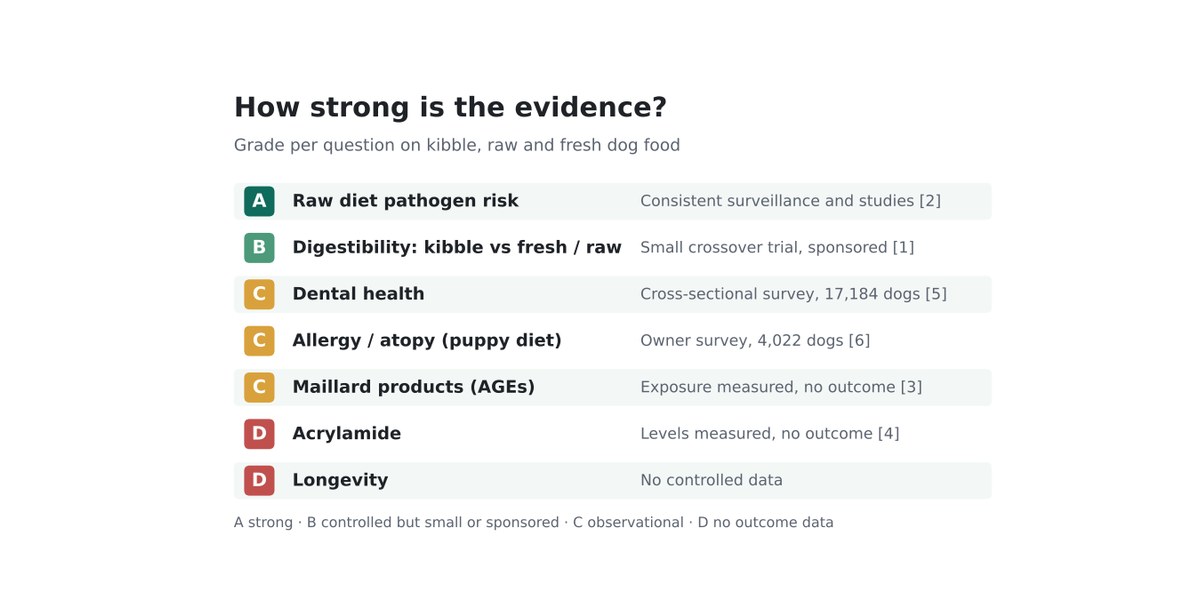
Grades: A = consistent controlled or surveillance evidence; B = controlled but small or sponsored; C = observational or survey; D = no health outcome data.
02The evidence, graded
| Question | Best study and design | Result | Funding or authors | Grade |
|---|---|---|---|---|
| Digestibility: kibble vs fresh and raw | Algya 2018; replicated 4×4 Latin square, 8 adult beagles, kibble vs two lightly cooked diets and one raw diet 1 | Lightly cooked diets had higher protein and fat digestibility than kibble; dry matter digestibility did not differ; all dogs stayed healthy | Freshpet, a fresh-food maker | B |
| Raw diet contamination | Davies 2019; review of surveillance and studies 2 | Repeated Salmonella and antimicrobial-resistant bacteria in raw diets and in the dogs fed them | UK government laboratory authors | A |
| Dental health | Buckley 2011; cross-sectional, 17,184 dogs 5 | Estimated probability of oral problems: 22% on dry food vs 41% on home-prepared diets | Mars/WALTHAM authors; no specific grant | C |
| Allergy signs | Hemida 2021; owner survey, 4,022 dogs 6 | At least 20% raw (and/or under 80% dry) in puppyhood linked to fewer owner-reported adult skin signs | Partly foundation-funded; support from raw and fresh pet food firms acknowledged | C |
| Maillard products (AGEs) | van Rooijen 2014; 67 commercial foods analysed 3 | Average estimated HMF intake per metabolic kg about 122× adult humans for dogs; canned foods highest on dry matter | Mars/WALTHAM co-author | D (exposure only) |
| Acrylamide | Veselá 2013; 5 dry dog and 3 dry cat foods 4 | 106–358 µg/kg in dry dog food; health effects not studied | Academic (Czech government grant) | D |
| Longevity | None found | No controlled or peer-reviewed study links food format to lifespan | — | D |
Table 1. Graded studies on kibble and dog health. Funding does not void a result, but it shapes which questions get asked.
03What is well supported
- Kibble is digestible. Properly extruded starch is more than 98% digested by dogs 7. Lightly cooked diets scored higher on protein and fat digestibility, but kibble stayed within healthy ranges 1.
- Raw carries real hazards. Pathogen and resistance findings are consistent across studies. Formal evidence for raw benefits covers only changes in the gut microbiome and, subjectively, stool quality 2.
- Formulation beats format. The review names poorly formulated, untested home-made and raw diets as a principal risk 2. A complete and balanced recipe, in any format, removes that risk.
04What is weak or missing
- AGEs and acrylamide. Both are present in pet food 34, but we found no study linking dietary levels to disease in dogs. Canned food is not lower in Maillard products on a dry matter basis 3, so this is not a kibble-only issue.
- The “ultra-processed” label. Processing classifications such as NOVA were built for human diets, and we found no dog trial testing them.
- Dental claims. Survey data favour dry food 5, but ordinary kibble does not replace brushing.
- Owner-reported outcomes. Survey links 6 cannot rule out that owners who feed raw differ in other ways.
- Heavy metals and ingredients. Testing is product by product, so it judges dog food brands, not the kibble format itself.
Cross-sectional survey of 17,184 dogs and 6,371 cats in Poland; association, not proof 5. Axis 0–100%.
View data table
| Group | Dry food (%) | Home-prepared (%) |
|---|---|---|
| Dogs | 22 | 41 |
| Cats | 24 | 56 |
05Dose, species and life stage
Dogs and cats eat more food per kilogram of body weight than people, so their estimated HMF intake per metabolic kilogram is far higher 3. Is dry food bad for cats? Cats digest properly processed starch well, at more than 93%, but starch affects their glucose and insulin less than in dogs, with delayed rises after some diets 8. Dog evidence should not be applied to cats. Life stage matters too: the allergy signal concerns puppyhood diet only 6. We found no study comparing formats in senior dogs or in dogs with kidney or gut disease, where diet choice is a veterinary decision.
Hydroxymethylfurfural (HMF), a Maillard reaction product, estimated from 67 commercial foods 3. Exposure only; no health outcome was measured. Axis 0–130×.
View data table
| Group | HMF intake vs adult humans |
|---|---|
| Dogs | 122× |
| Cats | 38× |
| Adult humans | 1× |
06What we would claim on pack, and what we would not
We would claim, with data
- “Complete and balanced” against FEDIAF or AAFCO profiles
- A digestibility figure from an in vivo trial on that recipe
- “Supports dental health” only after a dental trial on that kibble
- Process controls that limit Maillard products
- Pathogen-tested, with the method stated
We would not claim
- “Kibble-free means healthier” or “kibble causes disease”
- “More natural, so more digestible” with no trial
- “Cleans teeth” for standard kibble
- “AGE-free” or “acrylamide-free”
- “Adds years to your dog’s life”
Complete and balanced kibble is a sound way to feed a healthy dog on current evidence. The real risks sit in poor formulation and in raw-diet pathogens, and the open questions, such as Maillard products, apply to every cooked format.
07For brands and formulators
08Questions owners and brands ask
Is kibble bad for dogs?
We found no good evidence that complete and balanced kibble is bad for healthy dogs. No controlled study shows that it shortens life or causes disease.
Is kibble or raw food better for dogs?
Raw diets change stool and the gut microbiome, but wider benefits lack robust evidence, and pathogen risks such as Salmonella are well documented.
Does kibble clean dogs’ teeth?
Dry food is linked with fewer oral problems in a large survey, but only a dental trial on a specific kibble supports a claim, and brushing still matters.
Kibble vs wet food: which is better?
Neither format is proven healthier. Canned food is not lower in Maillard products on a dry matter basis, so choose a complete diet the dog does well on.
Sources
- Algya KM, Cross TL, Leuck KN, Kastner ME, Baba T, Lye L, de Godoy MRC, Swanson KS (2018). Apparent total-tract macronutrient digestibility, serum chemistry, urinalysis, and fecal characteristics, metabolites and microbiota of adult dogs fed extruded, mildly cooked, and raw diets. Journal of Animal Science 96(9):3670–3683. Source ↗
- Davies RH, Lawes JR, Wales AD (2019). Raw diets for dogs and cats: a review, with particular reference to microbiological hazards. Journal of Small Animal Practice 60(6):329–339. Source ↗
- van Rooijen C, Bosch G, van der Poel AFB, Wierenga PA, Alexander L, Hendriks WH (2014). Quantitation of Maillard reaction products in commercially available pet foods. Journal of Agricultural and Food Chemistry 62(35):8883–8891. Source ↗
- Veselá H, Šucman E (2013). Determination of acrylamide in dry feedstuff for dogs and cats. Acta Veterinaria Brno 82(2):203–208. Source ↗
- Buckley C, Colyer A, Skrzywanek M, Jodkowska K, Kurski G, Gawor J, Ceregrzyn M (2011). The impact of home-prepared diets and home oral hygiene on oral health in cats and dogs. British Journal of Nutrition 106(S1):S124–S127. Source ↗
- Hemida MBM, Salin S, Vuori KA, Moore R, Anturaniemi J, Rosendahl S, Barrouin-Melo SM, Hielm-Björkman A (2021). Puppyhood diet as a factor in the development of owner-reported allergy/atopy skin signs in adult dogs in Finland. Journal of Veterinary Internal Medicine 35(5):2374–2383. Source ↗
- Carciofi AC, Takakura FS, de-Oliveira LD, Teshima E, Jeremias JT, Brunetto MA, Prada F (2008). Effects of six carbohydrate sources on dog diet digestibility and post-prandial glucose and insulin response. Journal of Animal Physiology and Animal Nutrition 92(3):326–336. Source ↗
- de-Oliveira LD, Carciofi AC, Oliveira MCC, Vasconcellos RS, Bazolli RS, Pereira GT, Prada F (2008). Effects of six carbohydrate sources on diet digestibility and postprandial glucose and insulin responses in cats. Journal of Animal Science 86(9):2237–2246. Source ↗
Evidence reviewed by the Guires Pet Nutrition Lab scientific team. This article is general information for product developers and is not legal or veterinary advice.
How to cite this article
Choose your referencing style, then copy. Check your university’s, journal’s or regulator’s guide for local variations.
Mehta, P. (2026, November 10). Is kibble bad for dogs? What the evidence actually shows. Guires Pet Nutrition Lab Insights. https://www.petnutritionlab.com/insights/is-kibble-bad-for-dogs
Mehta, Priya. “Is kibble bad for dogs? What the evidence actually shows.” Guires Pet Nutrition Lab Insights, 10 Nov. 2026, www.petnutritionlab.com/insights/is-kibble-bad-for-dogs. Accessed [date].
Mehta, P. (2026) Is kibble bad for dogs? What the evidence actually shows. Available at: https://www.petnutritionlab.com/insights/is-kibble-bad-for-dogs (Accessed: [date accessed]).
Mehta, Priya. “Is kibble bad for dogs? What the evidence actually shows.” Guires Pet Nutrition Lab Insights. November 10, 2026. https://www.petnutritionlab.com/insights/is-kibble-bad-for-dogs.
Priya Mehta, ‘Is kibble bad for dogs? What the evidence actually shows’, Guires Pet Nutrition Lab Insights, 10 November 2026, <https://www.petnutritionlab.com/insights/is-kibble-bad-for-dogs>, accessed [date accessed].
Mehta P. Is kibble bad for dogs? What the evidence actually shows [Internet]. Guires Pet Nutrition Lab Insights; 2026 Nov 10 [cited [date]]. Available from: https://www.petnutritionlab.com/insights/is-kibble-bad-for-dogs
P. Mehta, “Is kibble bad for dogs? What the evidence actually shows,” Guires Pet Nutrition Lab Insights, Nov. 10, 2026. [Online]. Available: https://www.petnutritionlab.com/insights/is-kibble-bad-for-dogs
@misc{guirespnl2026iskibblebadfordogs,
  author = {Mehta, Priya},
  title = {{Is kibble bad for dogs? What the evidence actually shows}},
  year = {2026},
  month = oct,
  howpublished = {\url{https://www.petnutritionlab.com/insights/is-kibble-bad-for-dogs}},
  note = {Guires Pet Nutrition Lab Insights}
}
This article summarises published evidence for product developers. Cite the original sources above for specific findings, and do not reproduce this article as your own work.
Building a dry food that stands up to scrutiny?
Send us your pack and web claims. We grade the evidence behind each one and design the tests that make it defensible.