Rescuing a premium wet dog food launch after repeated retort failures
A premium Indian pet food brand’s chicken-and-vegetable wet diet failed three production trials in a row after sterilisation. Guires PNL traced the cause to the formulation, not the retort, and validated a fix the manufacturer could run on its existing line.
Three batches. Three failures. Every time the cans came out of the retort, the gravy had split into a layer of yellow fat, the chunks had turned soft and grainy, and the product smelled faintly burnt. If your wet pet food looks perfect in the kettle and falls apart after sterilisation, this case describes your problem — and where to look for its cause.
Client name withheld. Project figures are shared with the client’s permission.
A recipe that worked in the kitchen — and failed in the can.
The brand was preparing to launch a chicken-and-vegetable wet diet for adult dogs. The recipe had been developed in a kitchen and scaled straight to a contract manufacturer’s retort line.
“Find out why our product keeps failing after sterilisation, fix it without changing our core recipe, and get us to launch.”
Three trials, the same four failures.
Fat separation
A visible oil layer on top of the gravy when the can was opened.
Texture collapse
Chunks lost their bite, and the gravy turned thin and grainy within weeks.
Off-odour
A cooked, slightly bitter note that pet parents described as “burnt”.
Colour drift
The gravy darkened from golden to brown during storage.
The manufacturer adjusted the retort cycle each time. Every adjustment fixed one symptom and worsened another: shorter cycles risked under-sterilisation, longer ones made texture and odour worse. By the third failure, the launch had slipped by ten weeks.
What retort does to a wet pet food emulsion.
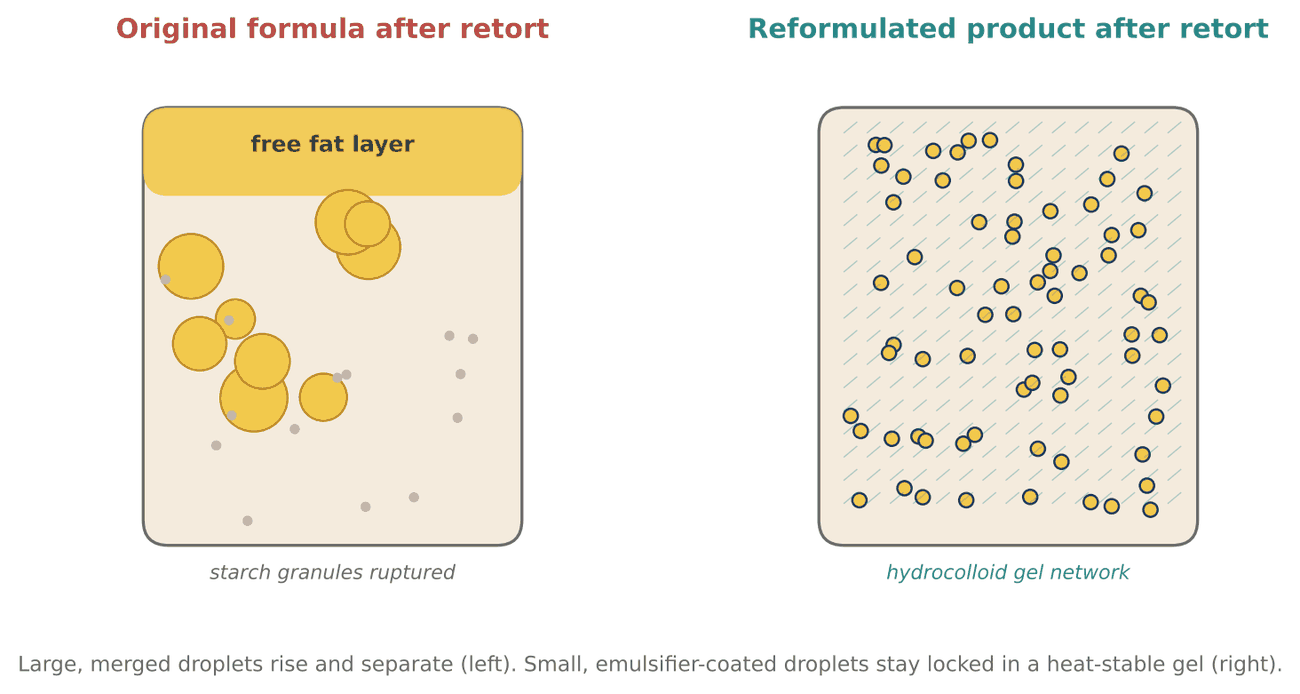
Five analyses on retained samples.
Our lab ran retained samples from all three batches, plus fresh kettle-stage samples, through five analyses:
| Analysis | What it measures | Key finding |
|---|---|---|
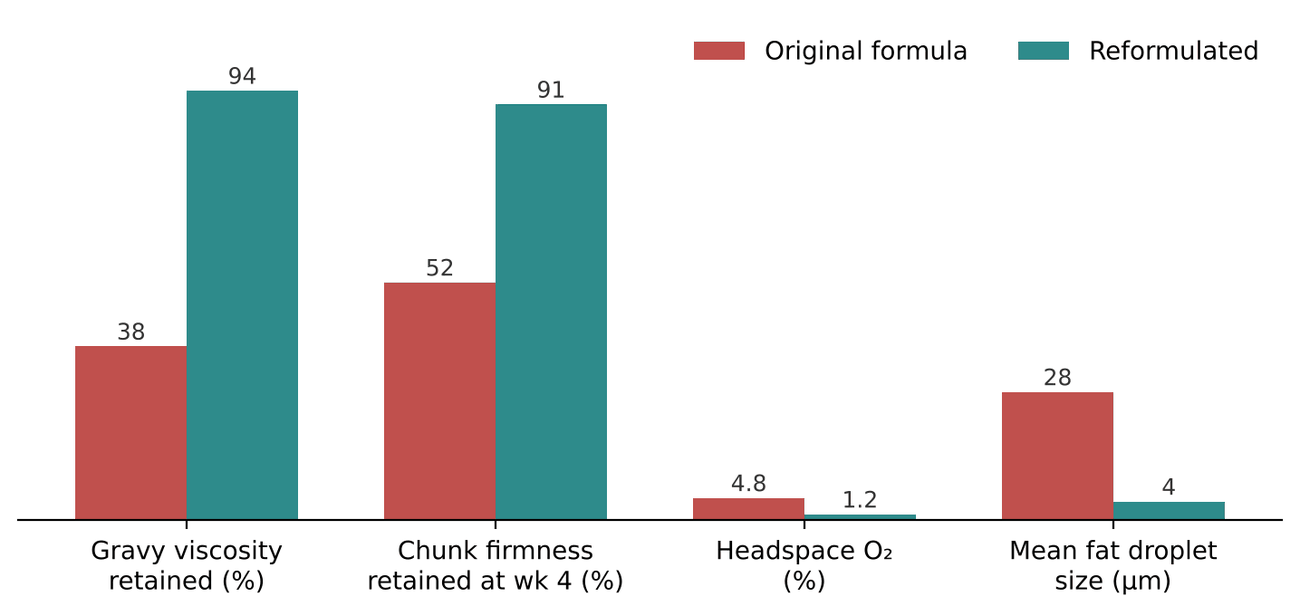
| Rheology | How the gravy flows and holds structure | Viscosity fell 62% from pre- to post-retort |
| Texture analysis | Firmness of the chunks | Firmness fell 48% by week 4 of storage |
| Microscopy / droplet sizing | Fat droplet size in the gravy | Mean droplet size grew from 4 µm to 28 µm |
| Headspace gas analysis | Oxygen left in the can | Residual O₂ 4.8%, against a 2% working target |
| Sensory panel | Trained 8-member panel, 9-point intensity scale | “Burnt” note rose from 2.1 to 6.4 over 8 weeks |
The retort itself was performing correctly. Thermocouple records at the slowest-heating point showed a minimum F₀ of 9.2 minutes against a 6-minute process target — more heat than the product needed. The failure sat in the formulation.
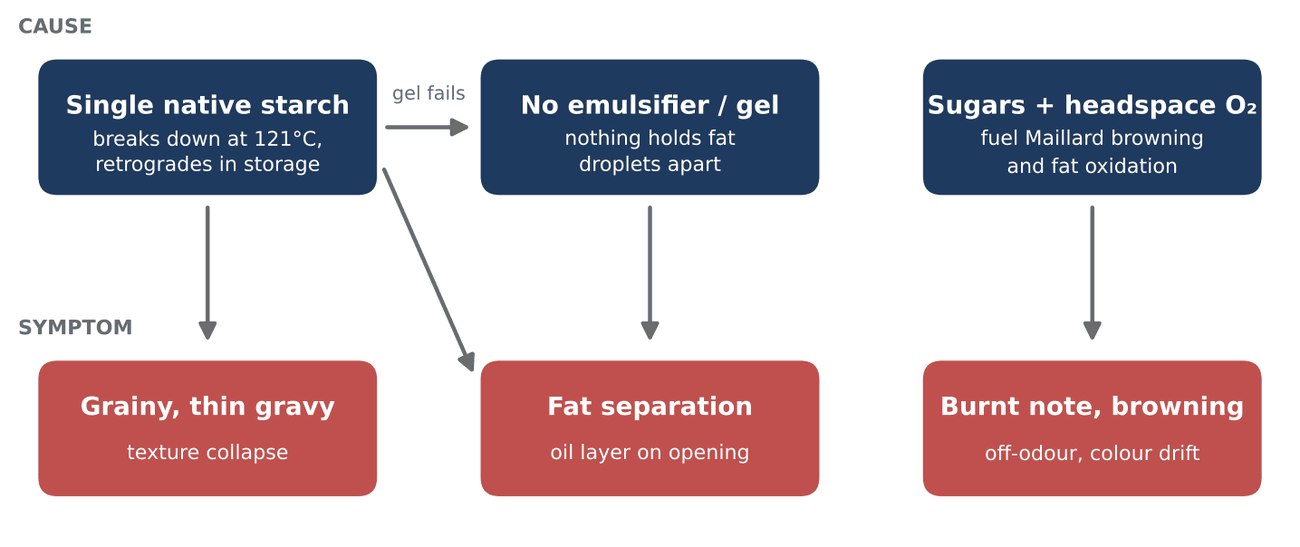
Three formulation choices, one failure cascade.
- A single native starch did all the thickening. It broke down under retort heat, then retrograded in storage — the grainy, thinning gravy.
- No emulsifier or heat-stable gelling system. Once the starch failed, nothing held the fat droplets apart, so the fat separated.
- Excess reducing sugars plus residual oxygen. Vegetable sugars fuelled the Maillard reaction, while oxygen in the can sped up fat oxidation — the burnt note and colour drift.
Coincidental, not causal: the chicken source, the vegetable cut size and the can format. Changing them would not have solved the problem.
Same recipe, new formulation architecture.
The core recipe — chicken, vegetables and nutrient profile — stayed the same. We rebuilt the formulation around it:
| Change | What was done | Why |
|---|---|---|
| Gelling system | Replaced the native starch with kappa-carrageenan, locust bean gum and guar gum | Kappa-carrageenan and locust bean gum form a firmer heat-stable gel together than either alone; guar adds gravy body; none of them retrograde 3. |
| Fat stabilisation | Added sunflower lecithin and high-shear pre-mixing to bring droplets below 5 µm | Smaller, coated droplets resist merging under heat 4. |
| Sugar load | Adjusted vegetable inclusion and pre-treatment | Fewer reducing sugars, less Maillard browning. |
| Headspace | Revised fill level and added steam flushing at filling | Lower residual oxygen, slower oxidation. |
| Process | Re-optimised come-up and hold times, targeting F₀ 6.5–7.5 minutes | Full sterilisation margin with less total heat. |
No new equipment was needed. The manufacturer’s existing retort line was used throughout — the expertise was in the diagnosis, not the hardware.
Proven on our pilot retort, four ways.
Sterilisation
Heat-penetration studies on 12 thermocouple-monitored cans at 121.1°C confirmed the 6-minute F₀ target; the lowest recorded value was 6.4 minutes.
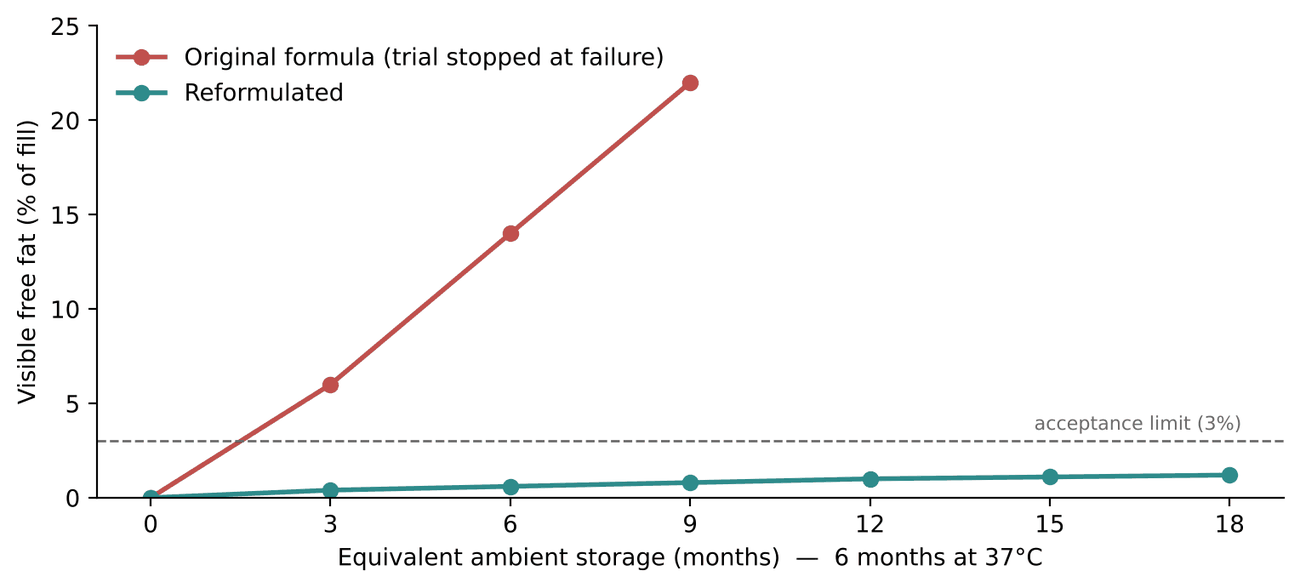
Accelerated shelf life
Cans held at 37°C for 6 months as a proxy for the 18-month ambient target. Visible free fat never exceeded 1.2% against a 3% limit; a real-time study continues.
Palatability
A monadic acceptance test on a 30-dog partner panel returned 92% acceptance, defined as eating at least 75% of the meal.
Launched seven weeks after engaging the lab.
The first commercial batch passed post-retort QC with a 0.4% rejection rate for separation or texture defects — down from batch-wide failure in all three earlier trials. Pet parents saw the same ingredients, now in a can that held up.
Everything needed to scale without us in the room.
- Final formulation sheet with ingredient specifications
- Process instructions, including pre-mix shear, fill weight and steam-flush settings
- Retort process schedule and F₀ validation records
- Critical control points and QC acceptance criteria
- Shelf-life and palatability study reports
Wet food is far less forgiving than dry.
India’s premium pet food segment is growing quickly, and many D2C brands built on dry food and treats are now moving into wet and retort formats. A recipe that works in a kitchen often fails under retort conditions, and contract manufacturers are usually set up to run a process, not to redesign a formulation. That gap is where most launch delays happen.
One caution: this case involved a chicken-based gravy product. Fish, red meat and plant proteins behave differently under heat, and each needs its own diagnosis.
Call your manufacturer — or a formulation lab?
| Call your manufacturer when… | Call a formulation lab when… |
|---|---|
| Failures are random across batches | The same failure repeats every batch |
| Seal, can or temperature records show deviations | Retort records are in spec but the product still fails |
| The issue appeared after a line or equipment change | The issue appeared from the first trial |
| Only some cans in a batch are affected | Separation, texture and odour problems appear together |
Frequently asked questions.
Why does my wet dog food separate after sterilisation?
Usually because the emulsion breaks under heat: fat droplets merge when nothing holds them apart. A single starch thickener, no emulsifier and large droplet size are common causes.
What F₀ value does canned pet food need?
The minimum botulinum cook is F₀ 3 minutes at 121.1°C. Commercial processes target a higher value for margin, set by a heat-penetration study for each product and can size.
Is my retort failure a formulation or a process problem?
If retort records are in spec and the same defect repeats every batch, the cause is usually in the formulation. Random or partial failures point to the process.
References
- US FDA. 21 CFR Part 113 — Thermally processed low-acid foods packaged in hermetically sealed containers. Source ↗
- van Rooijen C et al. (2013). The Maillard reaction and pet food processing: effects on nutritive value and pet health. Nutrition Research Reviews 26(2). Source ↗
- EFSA FEEDAP Panel (2022). Safety and efficacy of a feed additive consisting of carrageenan for pets and other non-food-producing animals. EFSA Journal 20(4):7285. Source ↗
- Wesker A (2023). The role of emulsifiers and stabilizers in wet pet food. GlobalPETS. Source ↗
- AAFCO. Dog and cat food nutrient profiles. Source ↗
- Bureau of Indian Standards. IS 11968:2019 — Pet food for dogs and cats. Source ↗
Final responsibility for product compliance rests with the brand owner placing the product on the market.
Have a wet food failing in production?
If your cans are splitting, thinning or smelling wrong after retort, the cause often lies in the formulation — and it can be diagnosed. Send us your failure details for a diagnostic review.
Every Guires PNL product is formulated to comply with the FEDIAF Nutritional Guidelines and the AAFCO Dog and Cat Food Nutrient Profiles. Neither body issues certificates to manufacturers, so compliance is verified independently against their published standards — and every product comes with a complete documentation package for regulatory submissions in the EU, US, Australia and Asian markets.
How we verify compliance →