From kitchen recipe to 5,000-unit production: scaling a fresh dog food brand in 90 days
A first-time founder had a gently cooked dog food recipe customers wanted to buy — but the contract manufacturer’s first run failed. Guires PNL took the recipe through nutrient analysis, reformulation, pilot processing, testing, labelling and tech transfer to a first production batch in 90 days.
You cook for your dog. Friends asked for a batch, then their friends did, and now your followers want to order. You found a contract manufacturer — but their first trial looked different, tasted different, and nobody could tell you how long it would last. If you are working out how to start a pet food brand from a recipe your dog loves, this is the gap you are standing in. Here is how one founder crossed it.
Client name withheld. Project figures are shared with the client’s permission.
A pet parent with a recipe and a plan.
The founder, a first-time entrepreneur in a metro city, had spent two years refining a gently cooked chicken, rice and vegetable recipe for their own Labrador. Demand from neighbours and a growing social following was real. The contract manufacturer’s first run was not: the texture was mushy, the colour dull, and two trial batches spoiled in the fridge within three days.
“Can you turn this into a product I can sell — safely, consistently and legally?”
What separates a kitchen recipe from a commercial product.
The recipe was not the problem — dogs loved it, and a home-cooked diet can suit an individual dog well. The gap was everything around it:
| Requirement | Where the founder started | What a commercial product needs |
|---|---|---|
| Nutritional adequacy | Not yet assessed | Complete and balanced to an AAFCO nutrient profile |
| Food safety | No defined cook step | Validated time–temperature control and microbial limits |
| Consistency | Cooked by feel | Written specification and SOP |
| Shelf life | Unknown | Validated under real storage conditions |
| Compliance | No label or test reports | Compliant label and test data mapped to IS 11968:2019 (India requirements) |
| Manufacturing | Manufacturer guessing the method | A complete tech-transfer package |
AAFCO analysis of the original recipe.
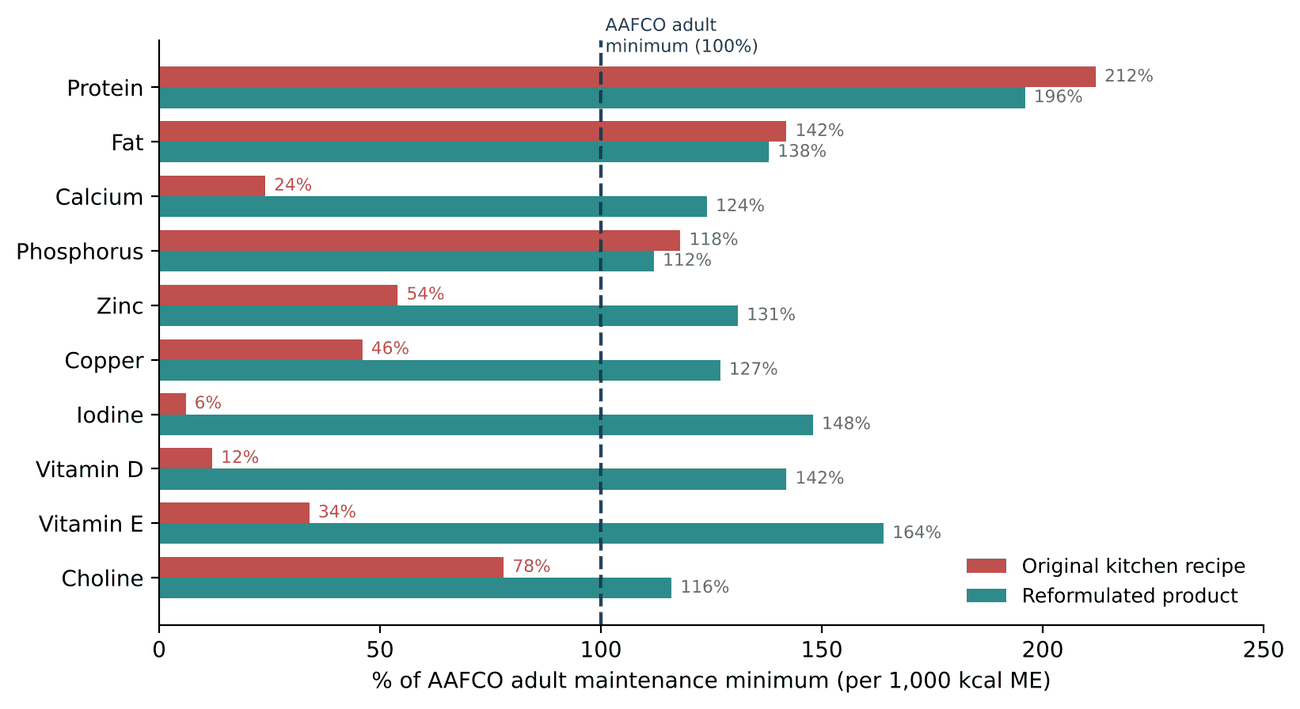
We modelled the recipe against the AAFCO Dog Food Nutrient Profiles for adult maintenance, per 1,000 kcal of metabolisable energy 1. Protein and fat were generous, but 7 of the 10 key nutrients we tracked fell below the minimum — calcium at 24%, vitamin D at 12% and iodine at just 6%. The calcium-to-phosphorus ratio was about 0.25:1, against AAFCO’s range of 1:1 to 2:1.
This is common, not careless. A University of California, Davis study of 200 home-prepared dog food recipes found only 9 met AAFCO standards — including many written by veterinarians 2. Gaps like these usually show over months of feeding, not days.
Closing the gaps without losing the recipe.
The founder’s non-negotiable was clear: the food had to look and smell like the recipe their dog loved. We kept the core ingredients and closed the gaps in three moves:
- Swapped 6% of the chicken breast for chicken liver — a natural source of copper, vitamin A and flavour.
- Added micronised calcium carbonate to correct calcium and the calcium-to-phosphorus ratio.
- Built a recipe-specific vitamin–mineral premix for zinc, iodine, vitamin D, vitamin E and choline, instead of a generic blend that would over-supply some nutrients.
The compromise: the first bench batch tasted faintly chalky and the gravy turned gritty. Moving the premix into the sauce stage and switching to a finer calcium grade solved both. The formula was locked on day 28.
From saucepan to commercial kitchen.
A 3 kg saucepan forgives what a 150 kg kettle does not. In the first pilot batch, the vegetables turned to mush while the rice was still firm. We staged ingredient addition — protein first, rice next, vegetables last — and wrote down every critical step: a core temperature of at least 75°C held for 2 minutes, chilling below 5°C within 90 minutes, vacuum packing and blast freezing.
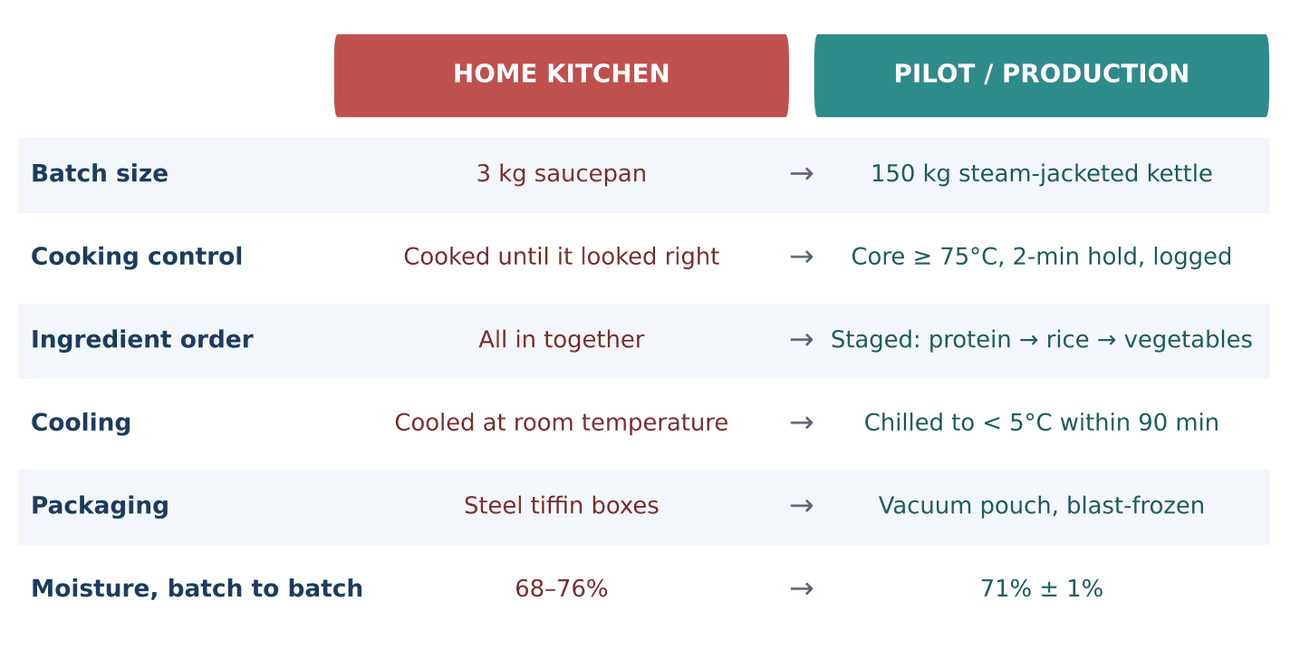
Across three pilot batches, moisture held at 71% ± 1%, compared with a 68–76% swing in the kitchen.
Safety, stability and palatability.
| Test | Method | Result |
|---|---|---|
| Proximate analysis | Protein, fat, moisture, fibre, ash (AOAC methods) | Matched formulation targets within label tolerances |
| Microbiology | Salmonella and Listeria monocytogenes (absent in 25 g), E. coli, Enterobacteriaceae | All within limits across three pilot batches |
| Frozen shelf life | Real-time at −18°C plus a −8°C temperature-abuse study; peroxide value, microbiology, sensory | Supports a 3-month frozen best-before; real-time study continuing toward 6 months |
| After thawing | Thawed packs held at 4°C and tested from day 0 to day 7 | Acceptable to day 5; label advises use within 3 days |
| Palatability | In-home monadic acceptance trial through our partner panel, 40 dogs, 5 days | 94% acceptance (finished ≥ 90% of the meal on at least 4 of 5 days) |
The launch shelf life is deliberately conservative: in frozen food the limit is usually quality, not safety, and only real-time data can extend it.
FSSAI, labelling and claims.
The founder’s first question was about an FSSAI licence. The factual answer: India does not yet have a dedicated licensing law for pet food. The Food Safety and Standards Act, 2006 covers food for human consumption, and the Delhi High Court has held that it does not extend to animal or cattle feed 4. What does apply:
- IS 11968:2019 — the Bureau of Indian Standards specification for dog and cat food 3. It is voluntary, but marketplaces and retailers increasingly ask for it, so our test reports were mapped to it.
- Legal Metrology (Packaged Commodities) Rules, 2011 — mandatory pack declarations, including net quantity, MRP, manufacturer details, best-before date and consumer-care contact 5.
- Claims — the “complete and balanced” claim was supported by an AAFCO nutritional adequacy statement (formulation method). “Human-grade” was removed, because the supply chain could not document it end to end.
The framework is evolving, so confirm current requirements before launch.
Handing off to the contract manufacturer.
- Final formulation and ingredient specifications
- Process SOP with critical limits for cooking, chilling and freezing
- HACCP plan with three critical control points: cook, chill and metal detection
- QC release specification and batch record template
Our team ran the manufacturer’s first trial batch alongside their staff; it passed first time.
Milestone by milestone.
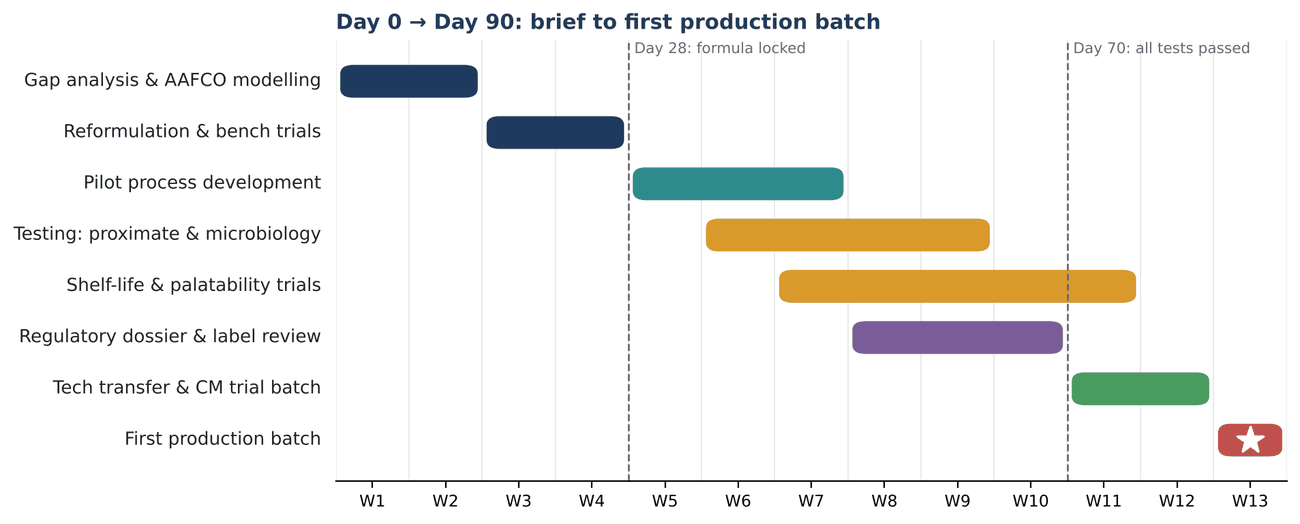
Testing ran longest, across weeks 6 to 11; overlapping it with pilot and regulatory work kept the project to 90 days.
Brand launched, first 5,000 units sold.
The first production batch passed every QC release check — cook and chill logs, moisture, microbiology and seal integrity. All 5,000 units sold within seven weeks through the brand’s website and two premium pet stores in its home city. The founder has since added a second recipe using the same SOP framework.
What to know before you start.
- Get a nutrient analysis before you get a manufacturer.
- Expect your recipe to change slightly — decide early what is non-negotiable.
- Write the cook down. Time, temperature and order matter far more at scale.
- Design shelf life around your cold chain, not the other way round.
- Budget for testing — it is usually the longest phase.
- Keep your vet involved. A formulation lab provides nutrition science and compliance, not clinical advice; dogs with medical conditions need a veterinary nutritionist.
Ninety days was achieved on this project. Timelines depend on product complexity, testing needs and how quickly decisions are made.
Frequently asked questions.
How do I start a pet food brand in India?
Begin with a nutritional analysis of your recipe, then develop a pilot-scale process, run safety, shelf-life and palatability tests, create a compliant label, and transfer the method to a contract manufacturer.
Do I need an FSSAI licence for pet food manufacturing?
India has no dedicated pet food licensing law today, and FSSAI’s mandate covers human food. Pet food is guided by IS 11968:2019 and the Legal Metrology rules. Confirm the current position before launch.
What does AAFCO “complete and balanced” mean?
The food meets every AAFCO nutrient minimum, without exceeding any maximum, for a stated life stage — shown by formulation or by a feeding trial.
References
- AAFCO. Dog and cat food nutrient profiles. Source ↗
- Stockman J, Fascetti AJ, Kass PH, Larsen JA (2013). Evaluation of recipes of home-prepared maintenance diets for dogs. Journal of the American Veterinary Medical Association 242(11):1500–1505. Source ↗
- Bureau of Indian Standards. IS 11968:2019 — Pet food for dogs and cats. Source ↗
- LiveLaw (2026). FSSAI can’t regulate animal feed under food safety law, scheme limited to food for human consumption: Delhi High Court. Source ↗
- Government of India. Legal Metrology (Packaged Commodities) Rules, 2011. Source ↗
Final responsibility for product compliance rests with the brand owner placing the product on the market.
Have a recipe you want to commercialise?
If your dog loves it and customers are asking for it, the next step is not a bigger saucepan — it is a nutrient analysis, a written process and real test data. We take founders from recipe to first production batch.
Every Guires PNL product is formulated to comply with the FEDIAF Nutritional Guidelines and the AAFCO Dog and Cat Food Nutrient Profiles. Neither body issues certificates to manufacturers, so compliance is verified independently against their published standards — and every product comes with a complete documentation package for regulatory submissions in the EU, US, Australia and Asian markets.
How we verify compliance →