Worked example: formulating an adult maintenance dog food to the FEDIAF nutritional guidelines
How do you turn the FEDIAF nutritional guidelines into a recipe a factory can run and a dog will eat? This worked example builds an adult dry dog food from nutrient profile to feeding guide, checked per 1000 kcal. It is an illustrative formulation by Guires PNL scientists, not a client project.
What the brief asked for.
- A complete and balanced dry food for adult dogs in the EU and UK, formulated to the FEDIAF nutritional guidelines 1.
- A named animal protein as the lead protein source, a mid-premium cost and standard extrusion.
- Label content ready for the pack, and a feeding guide that keeps dogs at a healthy weight.
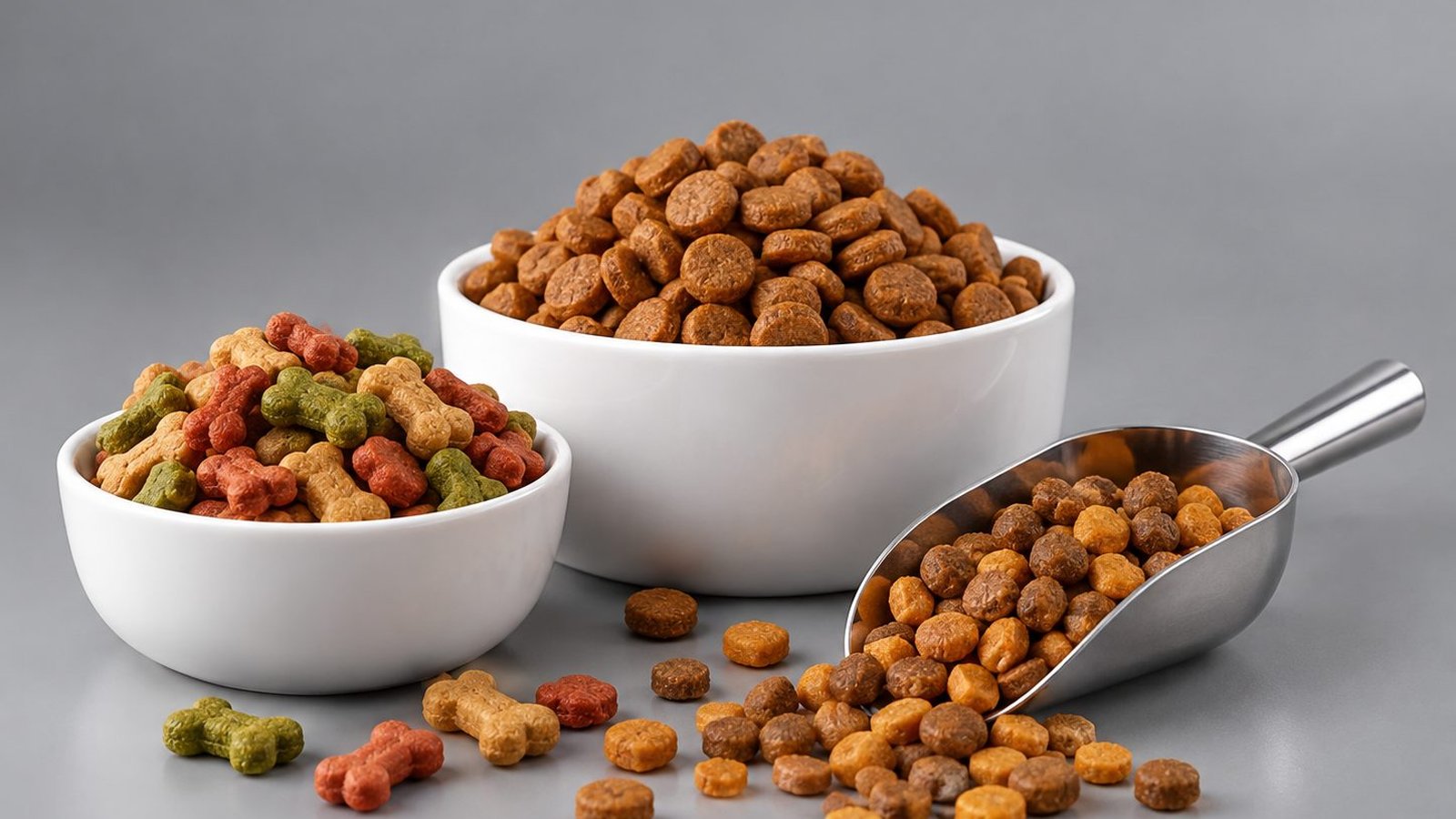
Worked example prepared by Priya Mehta, Guires PNL scientific team. Values are calculated, not analysed.
At a glance
- Format
- Dry extruded kibble, 8% moisture
- Life stage
- Adult dogs, maintenance
- Standard
- FEDIAF 2025, both adult columns: 110 and 95 kcal/kg0.75
- Energy
- 3,665 kcal ME/kg as fed (3,983 kcal/kg dry matter), calculated
Calculated values, as fed unless stated.
What had to hold.
Nutrients per energy
FEDIAF sets its adult minimums per 1000 kcal ME as well as per 100 g dry matter 1. Dogs eat to their energy needs, so every check here is per 1000 kcal at the recipe’s own energy density.
Two maintenance columns
FEDIAF gives adult values for an energy intake of 110 kcal/kg0.75 and a higher-density column for less active dogs eating 95 kcal/kg0.75: for example 45.0 versus 52.1 g protein per 1000 kcal 1. The recipe had to meet both.
Processing losses
In extrusion trials, vitamins A, D3 and K3 were the most easily degraded, and extrusion temperature significantly affected recovery of vitamin E and the B vitamins 2. Minimums must still hold at the end of shelf life.
Adult dog food formulation in seven steps.
Set the target nutrient profile
We took the adult maintenance minimums and maximums from the FEDIAF nutritional guidelines and set internal targets above each minimum 1.
Build the ingredient matrix
Proximates, amino acids and minerals for each ingredient came from typical published values. Client projects use supplier analyses instead.
Run least-cost formulation
Formulation software found the lowest-cost mix meeting every constraint. Potassium came from potassium chloride and zinc from the premix.
Convert to nutrients per 1000 kcal
ME was calculated with the modified Atwater factors of 3.5, 8.5 and 3.5 kcal/g 4: 3,983 kcal/kg dry matter and 3,665 kcal/kg as fed.
Specify the premix with overages
Vitamins come from the premix alone. We set overages of 30% to 100% by vitamin to cover extrusion and storage losses, with the largest for the vitamins most sensitive to extrusion 2. No iron was added: in the calculation, chicken meal alone supplies about four times the minimum.
Plan calculated versus analysed
The pilot batch is analysed and the results compared with the declared values, which must fall within the legal tolerances for labelling 5.
Write the feeding guide
Daily energy is 110 × body weight0.75 kcal 1, divided by the food’s energy density to give practical portion sizes.
The recipe
| Ingredient | Inclusion (%) |
|---|---|
| Broken rice | 31.15 |
| Chicken meal | 24.00 |
| Maize | 16.50 |
| Barley | 10.00 |
| Poultry fat | 9.00 |
| Dried beet pulp | 3.00 |
| Hydrolysed chicken liver palatant | 2.00 |
| Dried brewer’s yeast | 1.50 |
| Fish oil | 1.00 |
| Potassium chloride | 0.65 |
| Vitamin-mineral premix | 0.50 |
| Salt (NaCl) | 0.35 |
| Choline chloride (60%) | 0.20 |
| DL-methionine | 0.10 |
| Mixed tocopherols (antioxidant) | 0.05 |
| Total | 100.00 |
Illustrative inclusion levels from the least-cost run.
What the numbers show.
All 38 nutrients with an adult maintenance value in the FEDIAF tables meet the minimum in both columns, on calculated values. Ca:P is 1.44:1, inside the 1:1 to 2:1 range 1. Of the nutrients shown, the tightest margins are methionine + cystine and vitamin D3 against the low-energy column.
Key nutrients per 1000 kcal ME
| Nutrient | FEDIAF minimum, 110 / 95 kcal column | Calculated | % of 95 kcal minimum |
|---|---|---|---|
| Crude protein | 45.0 / 52.1 g | 62.1 g | 119% |
| Methionine + cystine | 1.91 / 2.21 g | 2.33 g | 105% |
| Crude fat | 13.75 g | 39.0 g | 284% |
| Calcium | 1.25 / 1.45 g | 3.11 g | 214% |
| Phosphorus | 1.00 / 1.16 g | 2.15 g | 185% |
| Zinc | 18.0 / 20.8 mg | 25.3 mg | 122% |
| Vitamin A | 1,515 / 1,754 IU | 2,273 IU | 130% |
| Vitamin D3 | 138 / 159 IU | 179 IU | 113% |
FEDIAF 2025 adult dog minimums 1; calculated values by Guires PNL. Calcium (3.11 g) and vitamin D3 (179 IU) sit well under their nutritional maximums of 6.25 g and 800 IU.
Worked example label
- Description
- Complete pet food for adult dogs. Worked example, not a real product.
- Composition
- Rice, chicken meal (24%), maize, barley, poultry fat, beet pulp, hydrolysed chicken liver, yeast, fish oil, minerals
- Energy
- 367 kcal per 100 g
Analytical constituents rounded for declaration 5. Ingredients are listed in descending order by weight, so rice comes first. Additives are the added amounts; zinc from the ingredients brings the total to about 93 mg/kg.
Feeding guide
| Body weight | kcal per day | Grams per day |
|---|---|---|
| 5 kg | 368 | 100 |
| 10 kg | 619 | 169 |
| 20 kg | 1,040 | 284 |
| 30 kg | 1,410 | 385 |
| 40 kg | 1,750 | 477 |
110 × body weight0.75 kcal per day ÷ 3.665 kcal/g. Less active or neutered dogs may need about 14% less (95 ÷ 110); adjust to body condition.
What we would do differently.
Supplier analyses
Chicken meal ash varies from lot to lot and shifts calcium and phosphorus. A client project would formulate on supplier certificates of analysis.
Digestible amino acids
Formulating on digestible rather than total amino acids 4 would give a truer methionine + cystine margin, which is only 5% over the low-energy minimum here.
Animal protein first
The brief wanted a named animal protein to lead, but rice outweighs chicken meal, so rice leads the label. Putting chicken first needs more meal, which raises cost, ash and calcium.
Energy and chloride
Modified Atwater factors tend to underestimate the energy of dry dog foods (see our dry matter basis guide), so feeding amounts should be checked against an analysed or trial energy value. Chloride, at about five times its minimum in the calculation, could be trimmed.
References
- FEDIAF (2025). Nutritional Guidelines for Complete and Complementary Pet Food for Cats and Dogs. European Pet Food Industry Federation. Source ↗
- Yang P, Wang H, Zhu M, Ma Y (2020). Evaluation of extrusion temperatures, pelleting parameters, and vitamin forms on vitamin stability in feed. Animals 10(5):894. Source ↗
- Regulation (EC) No 1831/2003 on additives for use in animal nutrition. Source ↗
- National Research Council (2006). Nutrient Requirements of Dogs and Cats. National Academies Press. Source ↗
- Regulation (EC) No 767/2009 on the placing on the market and use of feed. Source ↗
Worked example: values are calculated, not analysed, and must be confirmed by laboratory analysis before labelling. Final responsibility for product compliance rests with the brand owner placing the product on the market.
Formulating to FEDIAF?
Send us the species, life stage, format and market. A scientist will reply with a plan covering the right column, real overages, legal limits and proof by analysis.
Every Guires PNL product is formulated to comply with the FEDIAF Nutritional Guidelines and the AAFCO Dog and Cat Food Nutrient Profiles. Neither body issues certificates to manufacturers, so compliance is verified independently against their published standards — and every product comes with a complete documentation package for regulatory submissions in the EU, US, Australia and Asian markets.
How we verify compliance →