Reformulating a bestselling dry dog food to clean label — without losing palatability
An established Indian pet food brand asked Guires PNL to convert its top-selling adult dry dog food to a clean-label recipe — no artificial preservatives, colours or flavours — with equal palatability, an acceptable shelf life and an unchanged shelf price.
Your retailer wants “no artificial preservatives”. Your customers read ingredient lists. Yet your bestselling kibble still relies on BHA, BHT, a synthetic palatant and artificial colours. Swap them one-for-one and you risk what made it a bestseller: dogs that finish the bowl, a long shelf life and a price people pay. Here is how one brand kept all three — and what it cost.
Client name withheld. Project figures are shared with the client’s permission.
Clean label, on three strict conditions.
The brand wanted its top-selling adult dry dog food converted to a clean-label recipe: no artificial preservatives, colours or flavours, and a named protein source. The conditions were strict — equal palatability, a shelf life the trade would accept and an unchanged shelf price. Two modern-trade retailers had just introduced clean-label listing criteria.
“Clean label” is not a list of removals.
Each synthetic ingredient was doing a specific job, and its natural replacement does that job differently — at a different dose, cost and stability. Change one ingredient and the formula, the packaging and the shelf life all move with it.
Clean label, natural and organic.
What each synthetic ingredient was really doing.
We mapped every additive by its function in this formula, not by its category:
| Original | Real function | Replacement | Why this choice |
|---|---|---|---|
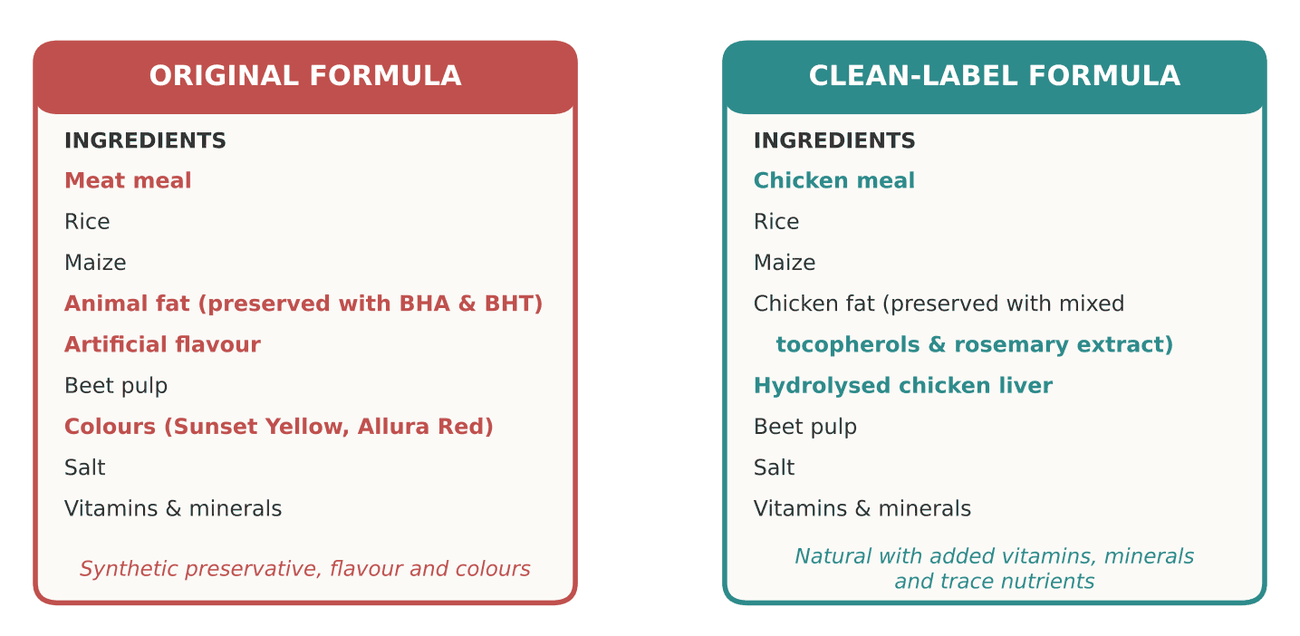
| BHA / BHT in fat | Stopped fat oxidation in the coating fat and on the kibble surface | Mixed tocopherols + rosemary extract + citric acid | Tocopherols are weaker per gram, so the dose rose about four-fold. Rosemary at full dose lowered intake in pilot feeding, so it is used only as a synergist. |
| Synthetic palatant | Drove first-choice aroma at the bowl | Hydrolysed chicken liver digest | A “natural” process under AAFCO; the closest aroma match of three digests screened. |
| Artificial colours | Uniform kibble colour for owners; no effect on dogs | Removed | Dogs do not choose food by colour. |
| “Meat meal” | Protein and flavour base | Named chicken meal | An identifiable source on the label. |
One change at a time, across four pilot runs.
Each swap was tested separately across four pilot extrusion runs. Two knock-on effects followed: tocopherols lose more activity through extrusion, so they moved to the post-extrusion fat coating; and the liver digest raised surface moisture, so drying time was extended to hold moisture at 9%.
The make-or-break test, run first.
A clean label is worthless if dogs walk away from the bowl. Natural digests vary more between batches than synthetic palatants, so palatability was the go/no-go gate before any shelf-life spend.
In a two-bowl paired-preference test, 30 adult dogs on our partner panel were offered both formulas side by side for two days, with bowl positions swapped daily to remove side bias. We measured share of intake and first choice.
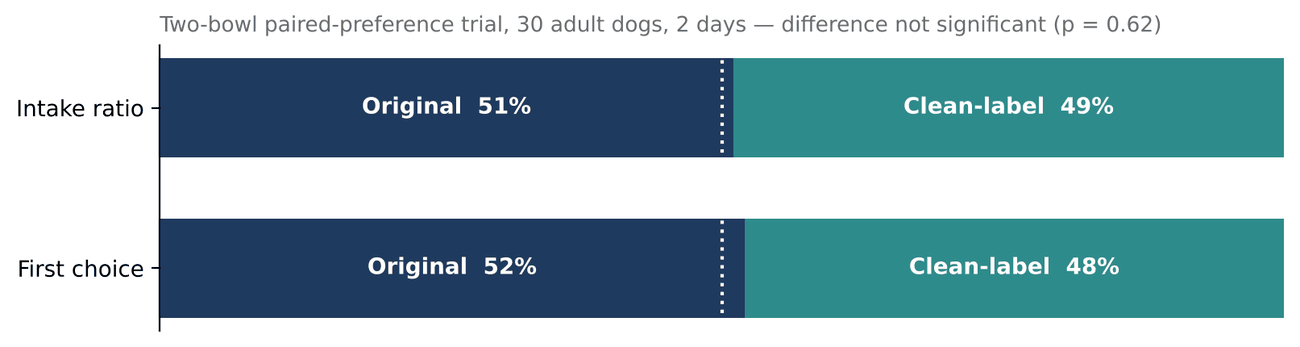
Intake split 51:49 and first choice 52:48 — no statistically significant preference (p = 0.62).
What changed — and what didn’t.
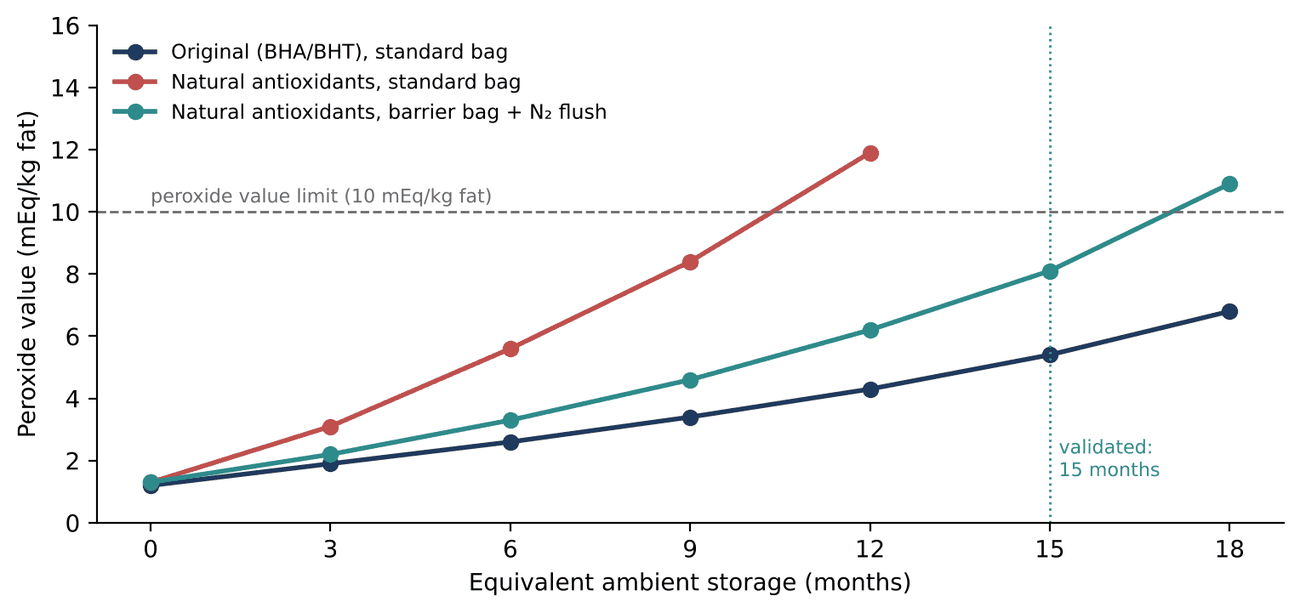
Natural antioxidants do not match synthetic ones like-for-like, consistent with published work on extruded dog food 2. In standard packaging, the new kibble reached the peroxide limit (10 mEq/kg fat) at about 10 months of equivalent storage, against more than 18 months for the original.
A high-barrier bag with nitrogen flushing slowed oxidation enough to validate 15 months, confirmed by hexanal testing and a sensory panel. The brand adopted a 15-month best-before in place of 18.
The honest numbers.
| Cost driver | Change per kg |
|---|---|
| Natural antioxidant system | +2.9% |
| Liver digest palatant | +1.8% |
| Named chicken meal | +0.6% |
| Barrier packaging + nitrogen flush | +1.8% |
| Total before procurement | +7.1% |
| Total after sourcing renegotiation | +4.6% |
A 12-month tocopherol supply contract and a second digest supplier, both secured by our sourcing team, cut the increase to 4.6%. The brand held its shelf price.
Launched nationally, listed by both retailers.
The clean-label line launched nationally, labelled “natural with added vitamins, minerals and trace nutrients”, and is formulated to meet the AAFCO adult maintenance nutrient profile, the FEDIAF Nutritional Guidelines and IS 11968:2019 3. In its first quarter, sell-through stayed within 2% of the previous formula, and both retailers listed the product.
For brands considering the transition.
- Map function before choosing replacements.
- Test palatability first — it is the cheapest failure to find.
- Budget for packaging, not just ingredients.
- Plan for a shorter shelf life and agree it with trade partners early.
- Use claims precisely — avoid absolutes such as “chemical-free”.
Frequently asked questions.
What does clean label mean in pet food?
It is an unregulated marketing term for short, recognisable ingredient lists without artificial additives. Unlike “natural”, which AAFCO defines, it has no legal standard.
Is BHA permitted in pet food?
Yes — BHA is permitted within defined limits by US and EU regulators. Brands replace it because of consumer and retailer demand, not because it is unsafe at permitted levels.
How do you replace BHA in dry dog food?
Use mixed tocopherols, usually with rosemary extract and citric acid, at a higher dose and applied after extrusion — and upgrade packaging to protect shelf life.
References
- AAFCO. “Natural” in pet food. Source ↗
- Gross KL, Bollinger R, Thawnghmung P, Collings GF (1994). Effect of three different preservative systems on the stability of extruded dog food subjected to ambient and high temperature storage. Journal of Nutrition 124(12 Suppl):2638S–2642S. Source ↗
- Bureau of Indian Standards. IS 11968:2019 — Pet food for dogs and cats. Source ↗
Final responsibility for product compliance rests with the brand owner placing the product on the market.
Ready to reformulate your existing line?
The risk isn’t the swap — it’s losing the palatability, shelf life or margin your bestseller depends on. We map your formula and prove palatability before you commit to production.
Every Guires PNL product is formulated to comply with the FEDIAF Nutritional Guidelines and the AAFCO Dog and Cat Food Nutrient Profiles. Neither body issues certificates to manufacturers, so compliance is verified independently against their published standards — and every product comes with a complete documentation package for regulatory submissions in the EU, US, Australia and Asian markets.
How we verify compliance →